Watching Dolphins From Shore: The Algarve’s Free Marine Safari
You do not need a boat tour to see dolphins on the Algarve coast. The waters offshore — particularly the stretch between Lagos and Cabo de São Vicente — are among the most reliable cetacean watching areas in European Atlantic waters. Three species are regular and predictable. Several viewing points on the clifftops are accessible by public bus or on foot. And unlike the commercial boat tours, the shore-based approach costs you nothing except a pair of binoculars and an early start.
Why This Coast Is Exceptional
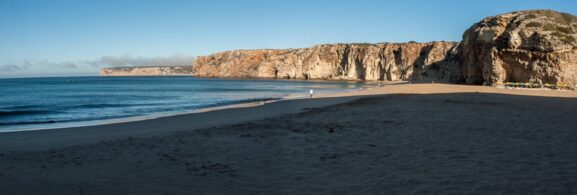
The Algarve’s southern coast sits at the boundary between the Atlantic’s temperate and subtropical zones, where nutrient-rich upwelling currents from depth meet warmer surface waters. This convergence creates what marine biologists call a high productivity zone — an area where small fish, squid, and crustaceans concentrate in large numbers, and where the predators that feed on them — dolphins, seabirds, and large fish — follow. The continental shelf here is relatively narrow, dropping to deep water within a few kilometres of shore, which means marine life is concentrated close to the coast rather than requiring offshore boat trips to reach.
The species most commonly seen from shore are the resident bottlenose dolphins (Tursiops truncatus), which live in the coastal waters year-round, and the short-beaked common dolphins (Delphinus delphis), which are present in larger groups during spring and summer as they follow seasonal fish migrations. Striped dolphins (Stenella coeruleoalba) are seen less frequently but appear in small groups several times each spring.
The Best Shore Viewing Points
Ponta da Piedade (Lagos)
The lighthouse headland at Ponta da Piedade is the most reliable land-based dolphin watching location on the Algarve. The cliffs here — some of the highest on the southern coast, rising 50 metres above sea level — give you a commanding view across the bay toward the open Atlantic. The resident bottlenose dolphin group that uses the Lagos-Portimão coastal waters passes through this bay regularly, often within 200–500 metres of the point.
Timing matters: the dolphins are most active — feeding, socialising, and travelling — in the morning hours, between 07:00 and 10:00. Afternoon sightings are possible but less consistent. Calm sea days are better than rough ones — in choppy conditions the dolphins spend more time at depth and surface less frequently.
From the lighthouse car park, walk south along the clifftop path to the series of viewing platforms. These are positioned at different height and angle; the most southerly platform, closest to the lighthouse, offers the widest view. Bring binoculars: even on good days, dolphins at 300 metres are small in your field of vision.
How to reach it: From Lagos, take the yellow tourist train (Trenista) from the marina, or walk the clifftop path west from Meia Praia beach (approximately 30 minutes). By bus, take route LG-1 from Lagos bus station to the Ponta da Piedade stop. Car parking is limited; arrive before 09:00 on weekdays, earlier on weekends.
The Seven Hanging Valleys Clifftop (Lagoa to Carvoeiro)
The Sete Vales Suspensos clifftop trail between Lagoa and Carvoeiro passes several high promontories that offer wide views over the offshore waters. The section between the Boca do Rio and the Praia da Boneca has the best sightlines. From these points — 40–60 metres above sea level — you can see 3–5 kilometres offshore on a clear day.
This area is particularly good for watching the interaction between dolphins and seabirds. When a group of dolphins is feeding below, gulls and gannets concentrate at the surface, diving where the dolphins drive fish upward. If you see a mass of gulls working an area offshore, it is worth spending 15 minutes watching — dolphins are usually present.
How to reach it: The trailhead near Carvalho is reached by bus from Lagoa or Carvoeiro. Park at the small car park at the trailhead (approximately €2).
The Sagres Clifftops
The headlands around Sagres — particularly the cliffs north of the Fortaleza de Sagres and the stretch toward Cabo de São Vicente — offer different dolphin watching opportunities from the main Lagos-Portimão stretch. Here you are looking out into the deeper Atlantic, and while sightings are less concentrated than at Ponta da Piedade, the species mix is different: deep-water species are more likely, and the sheer remoteness of the location adds to the experience.
The dolphins are not the only draw. The seabird colonies on the sea stacks below the Sagres cliffs include nesting sites for the rare Cory’s shearwater (Calonectris borealis) and the Balearic shearwater (Puffinus mauretanicus). In spring and early summer, the air above the cliffs is thick with these birds, wheeling on the updrafts from the cliffs.
How to reach it: Take bus 32 from Lagos to Sagres (approximately 1 hour 15 minutes). From Sagres village, walk or cycle the rough track to the Sagres headland. Allow a full morning for the trip.
What You Will See
Bottlenose dolphins (Tursiops truncatus) are the most predictable. They live in small resident groups of 5–15 individuals along this coast year-round. Each group has a stable membership, recognised by the shape and notching of their dorsal fins. Research groups in the Lagos-Portimão area have catalogued several hundred individual dolphins with documented home ranges. You may see the same group on multiple visits.
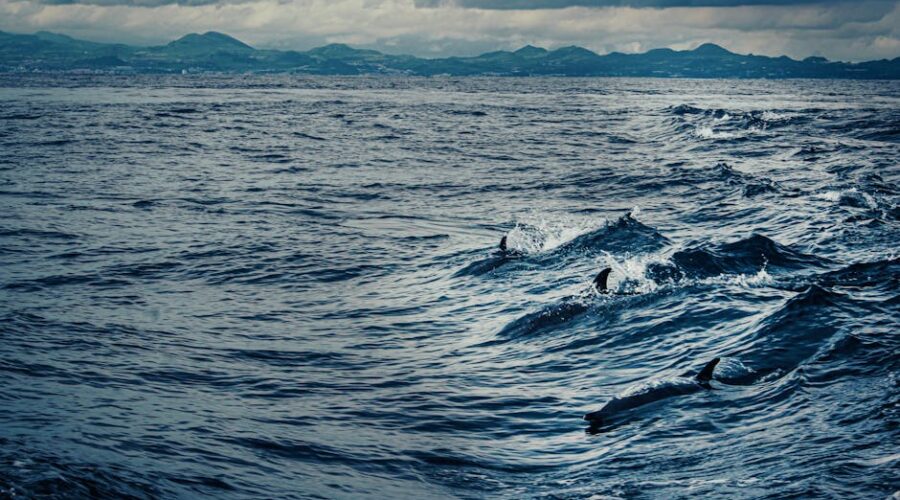
Bottlenose dolphin behaviour from shore is varied. They frequently travel in a predictable pattern — moving east along the coast in the morning, then reversing direction in the afternoon. When feeding, they concentrate in a small area and work cooperatively, herding fish toward the surface where seabirds join the action. Social behaviour — leaping, spy-hopping, and physical contact between individuals — is most commonly seen in the late afternoon and appears to be play rather than feeding-related.
Common dolphins (Delphinus delphis) are less predictable but more spectacular when they appear. They travel in larger groups — 20 to 100 or more — and their smaller size and energetic surface behaviour (porpoising, full breaches) makes them more visually striking than the bottlenose. They are most reliably seen from April through September, coinciding with the peak of the small pelagic fish migration.
When to Go
Spring (March–May): The transition period. Resident bottlenose dolphins are present year-round, but this is when common dolphins begin arriving in larger groups. Sea conditions can be changeable — a calm morning after a few settled days is your best bet.
Summer (June–August): The most reliable period for common dolphins. The sea is usually calmer and the dolphins more visible. The trade-off is more boat traffic — you will see the commercial dolphin watching boats working the same waters — and more visitors at the clifftop spots.
Autumn (September–November): The overlooked season. The water is still warm, the seas are often calm, and visitor numbers drop sharply after mid-September. Dolphin activity levels are similar to summer, but the clifftop spots are quieter.
Responsible Watching
Dolphins seen from shore are not habituated to boats, which means they are behaviourally more natural than the “wild” dolphins on commercial tours that have learned to approach vessels. The clifftop approach gives you the most authentic view of their natural behaviour.
If you are also considering a commercial boat tour (many operate from Lagos and Portimão marina), choose operators who are members of the Algarve Wildlife Watching Association and follow the national guidelines on minimum approach distances and maximum group sizes. Avoid operators who encourage swimming with dolphins or who make sustained engine-idle approaches to feeding groups.