Ponta da Piedade at Golden Hour: A Photographer’s Practical Guide
Ponta da Piedade at Golden Hour: A Photographer’s Practical Guide
If you’ve seen the photos of Ponta da Piedade and thought “I need to get there” — you’re right. But most people go at the wrong time, stand in the wrong place, and leave with shots that don’t match what they saw. Here’s what you actually need.
What is Ponta da Piedade?
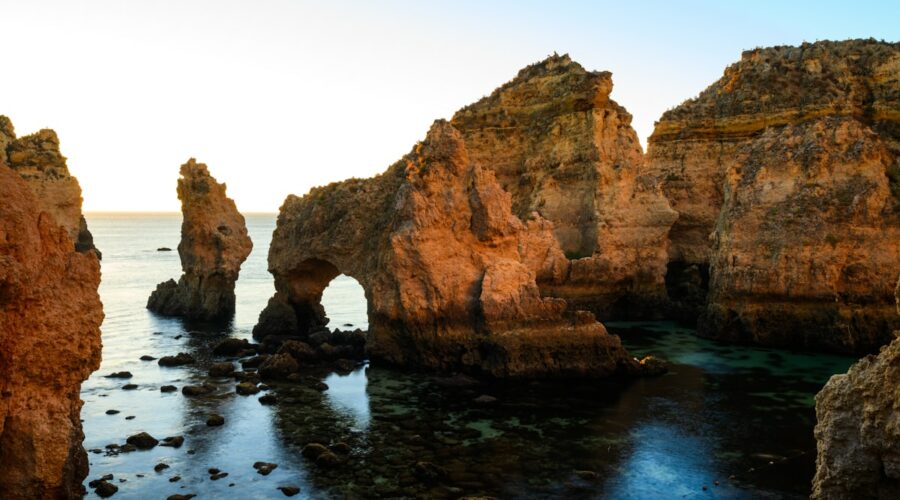
It’s a headland 2 km south of Lagos, famous for its sea stacks, grottoes, and lighthouse perched on a fractured limestone peninsula. It’s one of the most photographed locations in southern Portugal and one of the few where the photos actually look like what you see in person — the geology is genuinely that dramatic.
What most guides don’t tell you: there are actually three distinct viewpoints, each giving you a different perspective. And the time of day you choose changes which one is best.
Quick reference
- Location: 2 km south of Lagos city centre, municipality of Lagos
- Access: Free; a paved boardwalk runs from the car park to the main viewpoints
- Parking: Large free car park (roughly 100 spaces) — fills by 10am on weekends in spring
- Facilities: Toilets near the car park; cafe in the car park; no shade on the clifftop
- Best season: April–June and September–October
- Accessibility: The boardwalk is wheelchair-accessible to the main viewpoint; the lower clifftop paths are not
The three viewpoints — and when each works
Viewpoint 1: The Main Platform (the Instagram spot)
This is the stone platform above the sea stacks, reached via a short staircase from the boardwalk. It gives you the classic overhead view: the stacks, the lighthouse in the background, the blue water. From here you can see the main sea cave entrance.
Best time: Late afternoon, 5:30–6:30pm in April and May. The sun drops to the west and backlights the stacks, turning the rock faces warm orange while the water stays deep blue. This is the shot everyone wants. It’s also the most crowded viewpoint, especially in the hour before sunset.
Photography tip: Shoot from the left side of the platform for a cleaner angle with the lighthouse in frame. The right side has an ugly concrete barrier in the shot.
Viewpoint 2: The Lighthouse Clifftop (east side)
Follow the path past the main platform toward the lighthouse. This gives you an unobstructed view east toward Lagos Bay and the Alvor estuary. On calm mornings this side is calm and empty — the morning light comes from the east and turns the water silver.
Best time: Early morning, 7–8:30am. The lighthouse is behind you, the bay is in front, and on a clear spring morning the water is flat calm. Low tide reveals the rock platform below. This viewpoint is almost empty before 8am.
Photography tip: Use the cliff edge as foreground framing. The rock strata are clearly visible and make compelling leading lines toward the stacks.
Viewpoint 3: The Boardwalk Vista (south-facing)
The middle section of the boardwalk, where it curves south, gives you a head-on view of the open Atlantic with the stacks to your right. Less dramatic than the other two but much less crowded. Useful for a quieter composition with no people in the frame.
Best time: Mid-morning on overcast days. Harsh midday sun flattens the rock detail but works for long exposures on the ocean. The boardwalk has handrails to steady your shot.
Golden hour specifics
In April, golden hour at Ponta da Piedade falls between 6:45pm and 7:30pm. The sun sets to the west-southwest, meaning the backlit stacks shot is best from about 6pm onward. The light goes from warm to cool quickly once the sun drops; by 7:30pm you’re in blue hour and the lighthouse becomes the subject.
Bring a tripod if you want blue hour shots. The wind picks up at the clifftop, so use a sturdy tripod or brace against the stone wall.
What to bring
- Camera or phone: Both work here. Phones are fine for the main viewpoints. A wide-angle lens (14–24mm equivalent) helps capture the scale of the stacks.
- Polarizing filter: Cuts glare from the limestone and deepens the ocean colour. Especially useful in the afternoon.
- ND filter: Useful for smoothing water movement during blue hour or midday long exposures.
- Tripod: Only needed for blue hour and low-light shots; skip it if you’re here for the sunset golden hour.
- Water and sun protection: No shade at the viewpoint. April afternoons are warm.
Logistics for different trip types
If you’re coming from Lagos (easy option)
Drive or cycle the 2 km south from Lagos. There’s a dedicated coastal road. Parking is free. From Lagos city centre: allow 10 minutes by car, 25 minutes by bike. The road has a dedicated cycle lane.
If you’re combining with the Seven Hanging Valleys Trail
The trail ends at Benagil, which is 20 minutes east of Ponta da Piedade by car. If you walk the trail in the morning and want to photograph Ponta da Piedade in the evening, this works well. Don’t try to do both in one day with a start time that lets you catch golden hour.
If you’re coming from Sagres or the western Algarve
It’s a 50-minute drive from Sagres. If you’re based west of Lagos, leave Sagres by 5pm to make golden hour. Or plan the previous afternoon — Sagres to Ponta da Piedade is a pleasant evening drive.
How it compares to Benagil Sea Cave
The Benagil Sea Cave is 12 km east of Ponta da Piedade and often mentioned in the same article. They’re completely different:
| Ponta da Piedade | Benagil Cave | |
|---|---|---|
| Best for | Sea stacks, clifftop views, lighthouse | The sea cave interior |
| Access | Clifftop boardwalk; all ages | By boat or at low tide via beach |
| Crowd level | Moderate; spread across viewpoints | High; boat tours queue in season |
| Best time | Golden hour, evening | Late morning for cave interior light |
| Photography type | Wide landscape, clifftop | Interior cave, boat perspective |
One more thing: the weather forecast
Cloud cover is the variable that matters most for sunset photography here. A completely clear sky gives you strong contrast and warm tones. Light broken cloud (the kind that turns pink and orange) is often better than full clear — it diffuses the light and adds drama. Heavy cloud kills the golden hour shot but the lighthouse and stacks still look impressive in overcast light.
Check the Lagos marine forecast on IPMA (Instituto Portugues do Mar e da Atmosfera) before committing to an evening visit. Swell direction matters: a west swell makes the sea stacks more dramatic. An east wind flattens the water and reduces the drama of crashing waves.