The Seven Hanging Valleys Trail in Spring: What to Know Before You Go
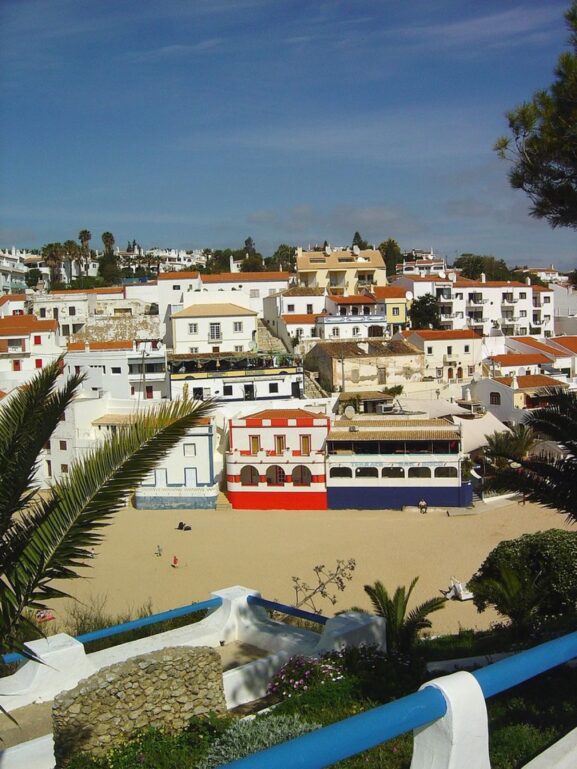
Photo: Roundtheworld · Wikimedia Commons · CC BY-SA 4.0
The Seven Hanging Valleys Trail — Spring Edition: What to Know Before You Go
The Seven Hanging Valleys Trail is the most-searched hiking route in the Algarve. It’s also the most misrepresented: half the content out there was written by someone who copied someone else’s description of a trail they maybe walked once. Here’s the version you actually need before you go.
What makes this piece different
Most guides cover the logistics. This one covers the decisions. Which direction to walk it. When to start. How to split the route if you only have half a day. Why spring conditions matter for trail quality. And what you’ll actually see at each section — measured, not described.
Quick reference
- Distance: 11.7 km one way
- Elevation gain: ~280 m cumulative
- Time: 4–5 hours at a moderate pace
- Difficulty: Moderate; one fixed-rope section
- Type: Linear — start and end points differ by ~1 km
- Best season: March through June; avoid after heavy rain
Where it starts and ends
The official trailhead is near Portozelo (Bordeira area), municipality of Lagos. The official end is near Lagoa municipality, close to the EN397 road at the Benagil end. Parking at the trailhead is free but limited to about 30 spaces — fill by 9am on spring weekends.
Drive times:
- From Lagos: ~35 minutes
- From Portimão: ~35 minutes
- From Faro: ~55 minutes
- From Sagres: ~75 minutes
What you’ll walk through
The route follows the clifftop for most of its length, cutting inland only twice. It’s well-marked with yellow-and-red waymarker posts, but erosion has widened some sections and the path isn’t always obvious. If you’re relying on phone GPS, download the map offline before you go — signal drops in several sections.
Section breakdown:
Portozelo to Praia da Rajada (first 1.8 km)
Gentle start on a wide track. The trail passes a restaurant and descends to the first beach via stone steps. This is the most crowded section in the first 30 minutes; tour groups start here.
Praia da Rajada to Praias da Margacadora and Castelejo (1.8–3.5 km)
The first real climb: 70 m of elevation over ~500 m. You’re on the clifftop now with open views south. This is the quietest section of the trail — most day-trippers turn back here.
To Praias do Couração and Cima (3.5–5 km)
A long, gradual descent with views over two small coves. These beaches have no facilities and are rarely crowded even in August. The trail narrows here; erosion has cut channels across the path.
To Praias do Carvalho and da Tartaruga (5–7 km)
The fixed-rope section. A ~15 m descent to Praia do Carvalho involves a handrope bolted to the rock. It’s exposed and can be slippery after rain. Allow 10–15 minutes for this section. The climb back up is the most physically demanding part of the trail.
To Benagil and the southern end (7–11.7 km)
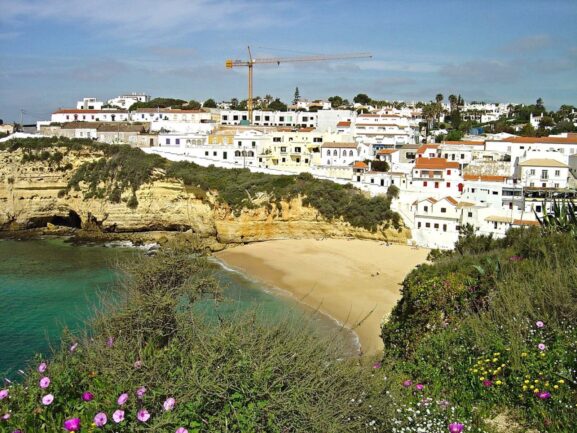
The final push crosses three more beaches. The most photographed viewpoint — the clifftop above Benagil — comes at approximately km 8.5, before the steep final descent to the beach.
Key decisions before you start
East-to-west or west-to-east?
Most people walk it east to west (Portozelo to Benagil). The logic: you get the easier first half — gentle climbs, manageable terrain — while your legs are fresh. The rope section comes in the second half when you’re warmed up. Downside: you’re walking against the flow of most other hikers, which means squeezing past on narrow sections.
Walking it west to east flips this. You tackle the rope section first (when you’re freshest) and face the longer climbs earlier. Some people prefer this; it feels more earned.
Either way, this is a linear route, not a loop. You need your own vehicle at both ends, or plan a taxi shuttle (expect to pay EUR15–25 between trailheads).
Half a day or the full route?
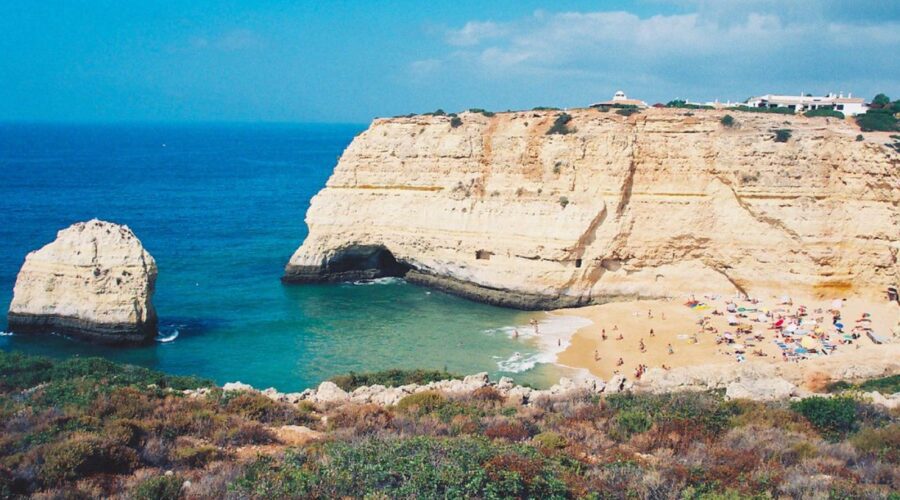
If you only have half a day, focus on the section from Praia da Rajada to Praia da Marinha. This covers the most visually dramatic geology — the layered limestone cliffs, the stack formations, the open ocean views. Turn back at Marinha; there’s a small car park here if you need a bail-out point.
Allow 2–2.5 hours for the partial route.
When to start
Spring weekdays: 8:30–9am start. You’ll have the trail largely to yourself until 11am.
Spring weekends: 7:30am at the latest. The parking at Portozelo fills by 9am on Saturdays and Sundays from April onward. By 10:30am, the section between Marinha and Benagil can feel crowded — it’s narrow here and passing other walkers takes time.
Start too late and you’ll be walking the exposed clifftop in full midday sun by 11am, with no shade.
What to bring
- Water: Minimum 1.5 L per person for the partial route; 2.5 L for the full traverse. No refill points on the trail.
- Shoes: Trail runners or hiking boots with good grip. The limestone gets slippery after dew or rain. Sandals are not appropriate.
- Sun protection: Hat, sunscreen. There is almost no tree cover from km 2 onward.
- Snacks: The only food stop is at the restaurant near the Portozelo trailhead (before you start) and the beach bars at Benagil (at the end). Nothing in between.
- Phone: Download the trail map offline. Battery bank recommended.
- Cash: For the restaurant if you stop before or after.
Trail conditions to check before you go
The trail is well-maintained but can be damaged by winter rains. The municipality of Lagos posts closure notices on its website when sections are unsafe. Check current conditions if it’s rained heavily in the week before your visit.
The fixed-rope section (Praia do Carvalho descent) is the most vulnerable to damage and the most dangerous when wet. If it has rained in the previous 48 hours, consider the partial route.
Alternatives if the trail is closed or too crowded
The Vicentine Coast stretch between Odeceixe and Zavial offers a similar clifftop experience with fewer people. It’s a 45-minute drive from Lagos and the geology is less dramatic, but the solitude is real. See the dedicated guide to that area.
The Almargem / Rota da Pedreira trail near Lagos is 6 km and visits the same rock formation types in a quieter setting. Allow 2 hours.