The First Half of June: Why Early June Is the Algarve’s Smartest-Kept Secret
Most travellers to Portugal pencil in July or August for an Algarve trip, convinced that summer is the only time the region delivers. That assumption costs them. The first half of June — the roughly two-week window before the Portuguese school holidays kick in and the coast starts filling up — is quietly one of the best times of the entire year to visit. The weather is already summer-grade. The trails are in excellent condition. The light is still soft enough to make photography extraordinary. And the beaches? You can still find them with room to breathe.
The Algarve in early June occupies a rare middle ground: warm enough to swim confidently in the Atlantic, dry enough for long days on trail, but not yet surrender to the high-season intensity that makes July and August feel more like a resort queue than a travel experience. If you are thinking about Portugal June travel timing, this is the version worth understanding.
What Early June Gives You
June Algarve weather at the start of the month tends to sit in a reliable 22–28°C range during daylight hours, with coastal sea temperatures warming to around 18–20°C — genuinely comfortable for swimming, not the bracing shock of May. Rain is rare. UV index climbs to high, which means sun protection is non-negotiable, but it also means you can plan full outdoor days without weather anxiety.
Daylight stretches to around 14.5 hours, with sunrise before 6:15 and sunset after 20:45 — giving long, usable windows for hiking, cycling, or moving between a morning walk and an afternoon beach stop. For early June Algarve hiking, this matters: you can comfortably fit a 15–20 km day without racing the light.
The trails in early June are typically in strong condition. Spring growth has stabilised soil on inland paths, the wildflower bloom is still visible in the Barrocal zone and along the Rota Vicentina, and coastal cliff paths have had months of dry weather to firm up footing. The heavy spring rain that can make March and April trails muddy is long gone, but the summer hardening of paths that makes June–July feel baked and bleached has not yet arrived.
Why It Beats Late May — and Why It Beats Late June
Late May has its merits, but early June represents a meaningful step change. Sea temperatures in late May still hover around 16–17°C — comfortable for a brave few but not yet the broadly accessible swimming conditions that June delivers. Trail vegetation is at its thickest in late May, with tall grass and scrub making some inland paths harder to follow. By early June, that growth has dried back just enough to open line of sight on routes like the Seven Hanging Valleys or the Fishermen’s Trail.
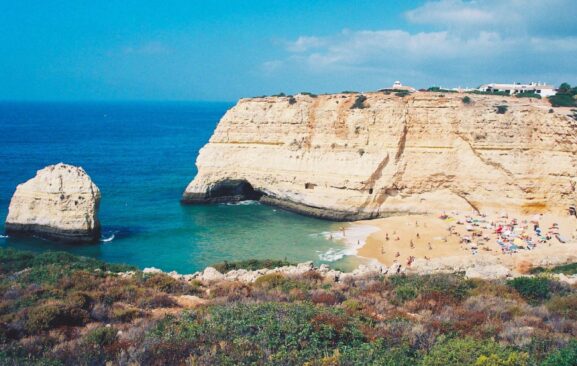
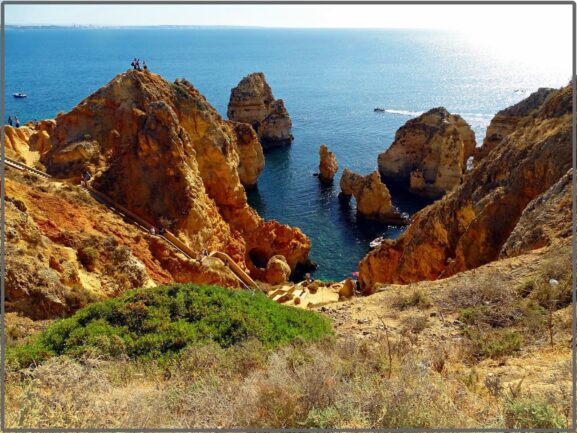
Against late June, the comparison is about crowds more than weather. June 15 marks the start of the Portuguese school holidays, and the coastal roads, beach car parks, and restaurant terraces change character almost overnight. By the second half of June, accommodation prices have spiked and popular spots like Ponta da Piedade, Praia da Marinha, and the coastal path around Carvoeiro start seeing real volume. Early June gives you the weather of late June with the relative quiet of May.
For those weighing Algarve summer start vs peak summer specifically, early June is the answer: you get summer conditions without the summer density.
Practical Tips for Early June
Pack sun protection as your single most important item — factor 30+ applied generously and reapplied every two hours if you are on water or sweating heavily. A light wind shell is worth carrying for early morning starts on exposed coastal cliffs, where the Atlantic breeze can still be cool before 8 am, even as temperatures climb through the day.
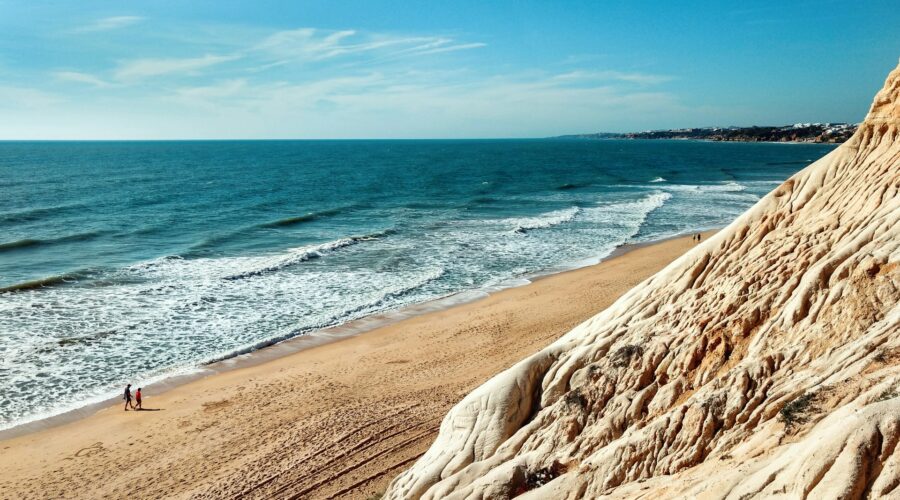
Trail conditions in early June are excellent for both the Via Algarviana’s inland sectors and the Rota Vicentina’s coastal paths. Water carries become important: carry at least 1.5 litres on any day walk, as spring-fed sources along inland routes may have reduced flow. Walking poles are useful on the sandier sectors of the Fishermen’s Trail between Zambujeira do Mar and Odeceixe.
For swimmers: the water is genuinely pleasant by early June, particularly on the southern coast between Tavira and Lagos, where the sea is calmer than the Atlantic-facing west. The east side of the Ria Formosa and the sheltered coves around Carvoeiro warm fastest.
Local Safety Note
If you are walking the Seven Hanging Valleys trail or any coastal cliff path in early June, be aware that unofficial sea-access points can be slippery after morning dew — wait until mid-morning for surfaces to dry if you are heading down to coves. The national beach authority (APA) issues daily flag conditions at all formal beach access points; these are displayed at beach entrances and are reliable for assessing same-day safety. For real-time sea conditions on the west coast, check the IPMA marine forecast at ipma.pt before setting out — the Atlantic in June can produce stronger swell than the south coast’s sheltered waters suggest.