The Interior Heritage Route: A Driving-Cum-Walking Route Through the Algarve’s Forgotten Country
Most visitors to the Algarve never leave the coast. Those who do typically drive straight through on their way to Spain or Lisbon, stopping only for fuel. That is their loss. The Algarve’s interior — the Barrocal zone of rolling limestone hills and the flat scrubland beyond — contains a Portugal that the coastal resorts have polished into a postcard and sold back to tourists at a premium. Here, in the villages between São Brás de Mexiquelós and Alcoutim, the old patterns of life persist: pottery made by families who have worked the same clay for generations, market days that draw buyers from across the region, bread baked in wood-fired ovens that have not changed in a century, and a quiet that coastal visitors cannot imagine.
This route is designed for people who have already walked the cliff paths and want to understand what lies behind them — the economic and cultural landscape that produced the Algarve they came to visit. It works as a full-day circular drive with short walks, or as a two-day slow route with an overnight stay in one of the small inland towns. It requires a car. It costs almost nothing to follow.
The Route Concept
The route connects five interior nodes: São Brás de Mexiquelós, the ceramic village of CYPRE, the market town of Almodôvar, the river border town of Alcoutim, and the marsh and salt pan zone around Castro Marim. Each has a distinct character, and the drives between them — typically 20 to 40 minutes — pass through a landscape that changes markedly as you move from the tourist interior to the agricultural interior to the wild interior near the Spanish border.
The route is not a single signed itinerary. It is a loose sequence that you adapt to your own timing, your interest in stopping, and your willingness to take minor unpaved roads when they offer a more direct or more interesting path.
São Brás de Mexiquelós: The Museum Town
São Brás de Mexiquelós is the least visited of the Algarve’s three principal interior towns, and that is partly by design — its local authority has invested in cultural infrastructure without building the tourist facilities that would attract day-trip coaches. The Museu do Centro oleiro displays the pottery tradition of the São Brás region, with demonstrations of hand-thrown and moulded earthenware. The museum gift shop sells directly from the workshop at prices that are a fraction of what equivalent work costs in Lagos or Albufeira. This is the most direct way to buy locally made pottery in the Algarve — not in a tourist shop, but from the town where the tradition has been continuous since the 18th century.
The Tuesday morning market in São Brás is a genuine local market, not a tourist market. You will find fruit and vegetables from smallholders, live animals, hardware, clothing, and a food section where the açorda de marisco costs €4 and the migas is made the way it has always been made. Sit at a plastic table and eat with the farmers.
How to reach it: From the A22 motorway, take the São Brás de Mexiquelós exit. Parking is free in the centre. The market runs from roughly 08:00 to 13:00 every Tuesday.
CYPRE: The Ceramic Village
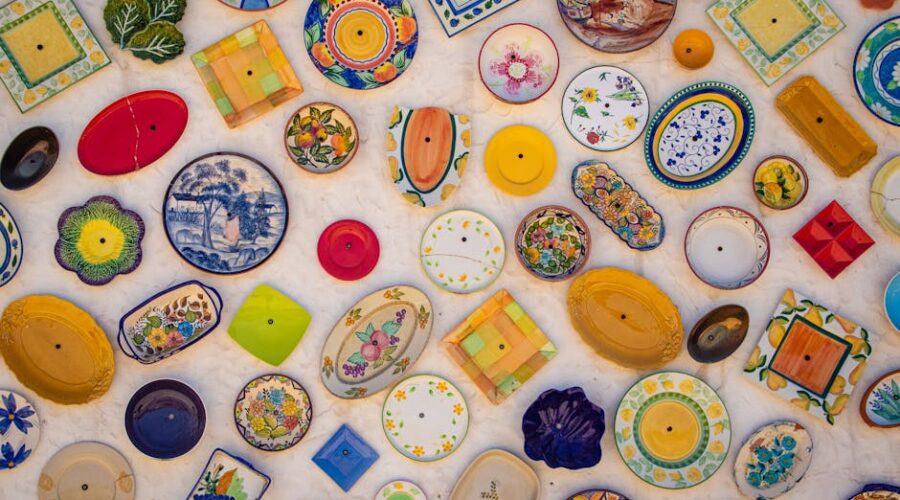
The small settlement of CYPRE — officially CYPRE but signed as CYPRE on the regional maps — lies on the road between São Brás and Almodôvar. It is one of the most concentrated pottery centres in the Iberian Peninsula. Workshop after workshop lines the main street, stacked with water jugs, bread pots, cazuelas, and the distinctive orange-glazed earthenware that the region has produced since the Moorish period. Most workshops sell directly. Many will show you the wheel if you ask politely and are not in a rush.
This is not a curated tourist experience. It is a working craft economy that happens to have decided to sell to whoever walks in. The quality of the work — particularly the water jugs and the large storage vessels — is exceptional, and the prices are roughly a tenth of what equivalent pieces cost in Lisbon or the Algarve coastal shops that import them from further away.
How to reach it: From São Brás, take the M506 towards Almodôvar. After approximately 12km, CYPRE is signed on the right. Allow 45 minutes to an hour for the stop if you want to visit several workshops.
Almodôvar: The Tuesday Market Town
Almodôvar is a small Alentejo-style town on the inland side of the Barrocal — technically in the Alentejo region but culturally continuous with the Algarve interior. Its Thursday market is one of the most genuinely local in the area: farmers from the surrounding scrubland bring produce, live animals, and the tools of a working agricultural life. It is not a tourist market. There is nothing here that is being sold to you as an experience.
Almodôvar also sits at the intersection of two of the Algarve’s most interesting secondary roads: the road north toward Santa Clara de ACODEIMBRA and the west road toward the Barragem de Campilhas, both of which offer access to walking routes that are entirely different in character from the coastal paths. If you are combining this heritage route with a walking element, the Santa Clara de ACODEIMBRA road leads to the Tapada de ACODEIMBRA, a private estate with limited public access but good surrounding walking on the public right of way.
How to reach it: Almodôvar is on the IC1 main road between Lisbon and the Algarve interior. The drive from CYPRE takes approximately 25 minutes via the M506 and the IC1.
Alcoutim: The River Border Town
Alcoutim sits on the Guadiana River directly across from its Spanish counterpart, Sanlúcar de Guadiana. The two towns are separated by roughly 400 metres of river. Until relatively recently, this crossing was made by small ferry; now a more formal crossing exists, but the river itself — slow, wide, olive-green in the afternoon light — still feels like a frontier.
The town has two claims on the heritage traveller. The first is the small museum of regional archaeology and ethnography in the centre, which documents the agricultural and fishing life of the river communities. The second is the river walk itself: a flat, paved circuit along the waterfront that takes roughly 30 minutes at a moderate pace, with views across to the Spanish bank and downstream to where the river bends out of sight.
Alcoutim is also the departure point for the Grande Rota do Guadiana, the long-distance walking and cycling route that follows the river eastward to the Spanish border and then north along the inland sections. A short day walk from Alcoutim toward the border crossing is one of the most peaceful walking experiences in southern Portugal.
How to reach it: Alcoutim is reached via the M501, which runs north from the A22 at the Castro Marim junction. The drive from Almodôvar takes approximately 50 minutes.
Castro Marim: Salt Pans and Marshland
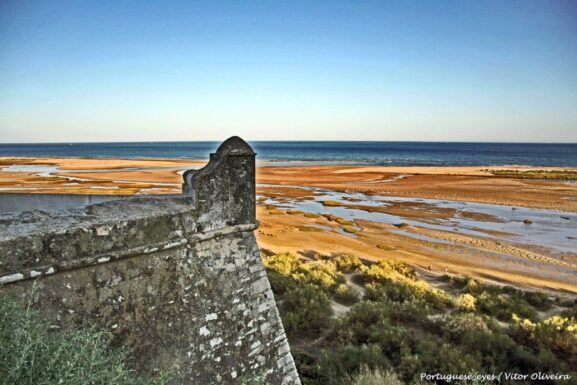
The loop returns to the coast at Castro Marim, where the salt pans that produce the Algarve’s most distinctive culinary export are visible from the road as vast white rectangles against the flat coastal plain. The Castro Marim salt pans are a nature reserve and a working salina simultaneously: the flamingos that feed in the shallow water during migration season share the pans with the workers who harvest the fleur de sel by hand. The combination of biological productivity and traditional working culture is one of the most intact in southern Europe.
The walk around the salt pan margins is free and open year-round. There is a small visitor information point at the entrance to the reserve with a map of the walking route. The circuit takes approximately 90 minutes and offers flamingo sightings, depending on season, from within 50 metres — closer than almost anywhere else in the Algarve.
How to reach it: From Alcoutim, return via the M501 to the A22, then south to the Castro Marim junction. The complete circuit from São Brás back to the coast takes between six and eight hours if you allow proper time at each stop.
Practical Notes
The route is not difficult, requires no special equipment, and is suitable for most vehicles. The roads between São Brás, CYPRE, and Almodôvar are a mix of regional tarmac and minor unpaved sections — the unpaved sections are passable in a standard car in dry weather. Navigation requires a combination of paper map and the regional signage, as not all minor roads are on mainstream GPS applications.
The best time to run this route is a Tuesday or Thursday, when the markets in São Brás and Almodôvar are running. An early start from the coast — departing by 08:00 — allows you to reach São Brás for the market opening, be in CYPRE by late morning, Almodôvar for the midday period, and still have time for Alcoutim and the salt pans before the late afternoon light.
The route is free to follow. The only paid admission on the full circuit is the pottery museum in São Brás (approximately €3), which is worth every cent of it.