Rota Vicentina After the Spring Rush: The Summer Walking Window
The conventional wisdom is blunt: do not walk the Rota Vicentina in summer. July and August are simply too hot, the trails too exposed, the risk of dehydration too high. And for through-walkers covering long daily distances in direct sun, this advice remains sound. But the blanket prohibition obscures a more nuanced reality — one that overlooks what June and the first half of July actually offer to walkers who plan sensibly and time their days correctly.
The shoulder season between the spring wildflower rush and the peak summer heat is, for many walkers, a superior experience to the crowded months of April and May. Here is why.
## What Changes in June
By early June, the wildflowers that made May so spectacular — the red poppies, the purple orchids, the yellows of the *Hymenocarpus* and *Spartium junceum* — have largely gone to seed. The hillsides that in April blazed with colour settle into a quieter, more muted green. For some walkers this will feel like a loss. For others, it will feel like the coast revealing its underlying character: the deep olive and grey-green of cistus scrub, the silver of olive leaves in the wind, the dark green of eucalyptus and cork oak forest that frames the trail through the Barrol zone.
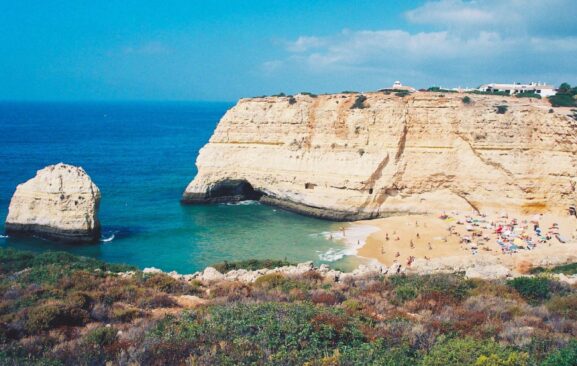
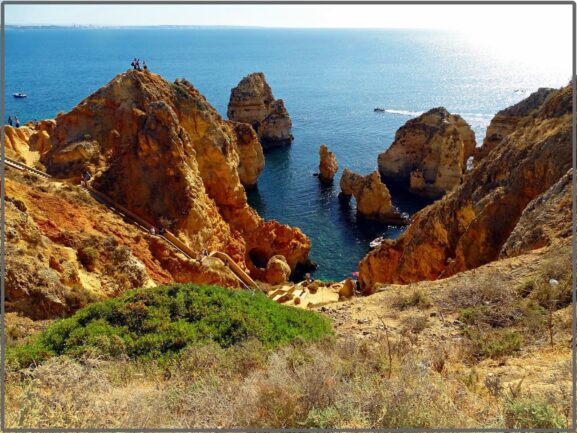
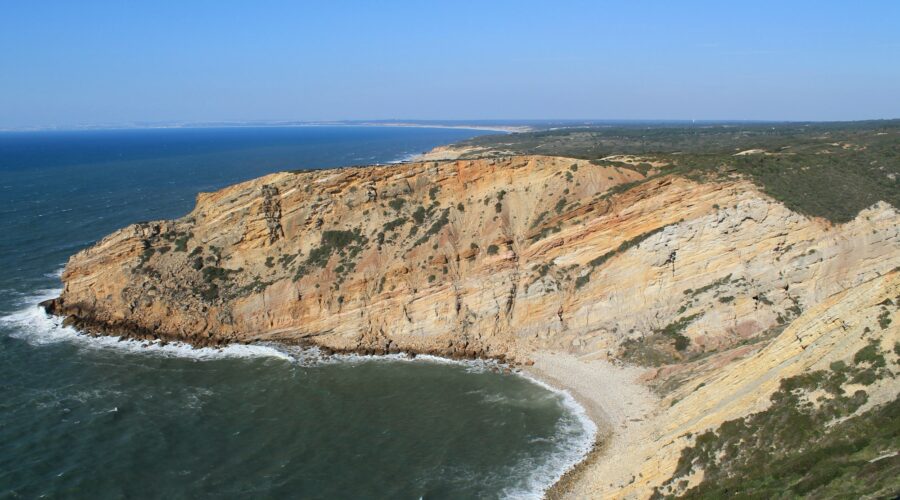
The coastal scrub stays surprisingly green in June along the Fishermen’s Trail, particularly the sections west of Vila do Bispo and around the Cabo de São Vicente Peninsula. Salt-tolerant species hold their colour longer than the inland vegetation, and the Atlantic marine layer — morning mist that rolls in from the coast and burns off by mid-morning — keeps the air humid and the vegetation from crisping as early as it does inland.
## The Practical Case: Beach Campsites at Their Best
The Rota Vicentina’s beach campsites — formal and informal areas where walkers can pitch near the shore — are at their cleanest and most serene in June. July sees the first wave of Portuguese coastal campers, families who arrive with cars full of gear and set up in the same locations that in May were available to any walker with a tent. By June, the sites are established, the bins are being emptied regularly, and the beach cleaning crews are on their summer schedule.
Specifically: the informal camping area at Praia do Castelejo (near Vila do Bispo) and the designated zone near Praia do Telheiro are both worth considering as overnight stops. Both have basic facilities and direct beach access. They are significantly less crowded in June than they will be in August.
## Water Sources: The Critical Detail
This is the piece of advice that most published guides either omit or bury. Many of the natural spring sources along the Rota Vicentina that are reliable in April and May are dry by mid-June. The spring at *Cerro das Águias* and several of the unnamed roadside taps between Odeceixe and Carrapateira have been non-functional in recent summers by early June. The ICNF waypoints and the Rota Vicentina official map show sources that may or may not be running.
The rule for June and July walking: carry 3 litres of water per person per day, and do not count on any source that is not in a village or marked as a official Rota Vicentina waypoint. The taps in Pedralva (a village that has been partially restored as a walking hub) are generally functional year-round. The taps at the aldeia of Rogil are also reliable. Everything else is an uncertainty. Start each morning with full bottles.
## Parking at Pedralva and Odeceixe
Pedralva village has a small, free car park at the village entrance — the same lot used by the Rota Vicentina transfer service. Arrive before 09:00 in June to guarantee a space. The village has two small cafés and a basic grocery shop, making it one of the most practical stops on the trail for independent walkers. Overnight parking is tolerated in the village lot if you are leaving the car while walking a multi-day section.
Odeceixe has a small earth car park at the top of the cliff path leading down to the beach and river mouth. It fills by mid-morning in July and August, but in June it rarely reaches capacity before 10:00. If you are organising a pickup or dropoff, plan it for the village upper road rather than attempting to turn in the narrow cliff-top lane.
## Camping on Public Beaches
Wild camping on the Rota Vicentina beaches is technically prohibited under Portuguese coastal protection legislation (the *Polis Litoral* regulations that cover the southwestern coast), though the rules are unevenly enforced outside the high summer months. June sits in a grey zone: formal campsite areas are available, and camping on the open beach will likely result in a visit from the *GNR* (National Republican Guard) who patrol the coastal zone, particularly around the most popular beaches. The enforcement presence is lower in June than in July and August, but it is not zero.
The practical compromise is to use the designated camping areas — they are not luxurious, but they are legal, they have basic facilities, and they put you on the beach without concern. The municipality of Vila do Bispo maintains two official beach camping areas in the summer months: one near Zavial and one near Cabo de São Vicente.
## The Nuanced Take on Summer Walking
The “do not walk in summer” advice is written for walkers doing 20–25km days with full backpacks, starting at 09:00 and finishing at 17:00, in temperatures that regularly exceed 32°C inland. That profile is genuinely dangerous in July. But if you start your walking day at 07:00, finish by 13:00, take a long afternoon break in the shade, and stick to the Fishermen’s Trail (which offers more natural shade from cliff and scrub than the more exposed Historical Way inland), June is entirely walkable and arguably more enjoyable than the crowded months of April and May. The days are long, the trails are dry and firm, and the coast is at its most alive.
The key variables are water, timing, and route selection. Get those right and the summer prohibition starts to look less like wisdom and more like caution that does not apply to your specific situation.