
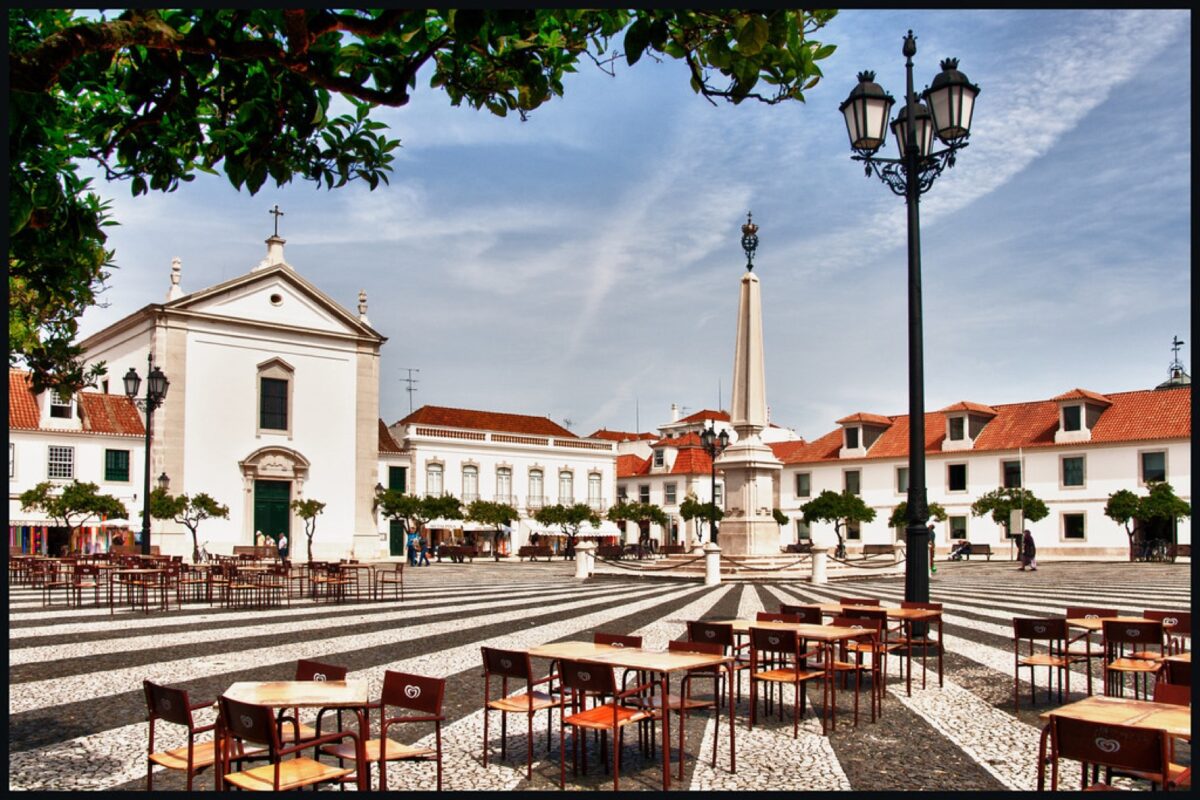
Vila Real de Santo António was drawn before it was built. The town went up in the 1770s on the Marquês de Pombal’s grid (the same rational, post-earthquake urbanism that rebuilt downtown Lisbon, stamped onto the mouth of the Guadiana), and the central square is the drawing at full strength. Black-and-white calçada radiates from the obelisk at the centre, orange trees stand in disciplined rows, and low Pombaline facades hold the perimeter in step.
The shot is symmetry. Stand at the centre and the pavement rays organise every direction; shift to the edges and the orange trees against whitewash give you colour and repetition. Detail hunters do well here too: fruit on the trees through winter and spring, tiled corners, the church holding one side of the square.
When to go: early morning, before the café terraces open, when the square is empty and low light rakes across the cobbles and pulls the pattern into relief. By lunch the square belongs to the town and the Spanish day-trippers off the Ayamonte ferry: livelier, less geometric.
The riverfront is a short walk away, and the ferry across to Ayamonte turns the visit into a two-country afternoon. The whole town centre is flat and effortless to cover on foot.
Who it’s for: urban geometry shooters, architecture fans who have had their fill of castles, and anyone who wants to see Enlightenment town-planning still doing its job.
About This Spot
-
General AreaNear Vila Real de Santo António, Vila Real de Santo António
-
Coverage BadgeArchive
-
Difficulty1 Easy
Getting There & Access
-
Getting ThereThe square is the dead centre of Vila Real de Santo António's grid: park near the riverfront and every street funnels you toward it.
-
Access TermsFree Public
-
Best TimeMorning
-
Crowd LevelModerate
Photography Notes
-
Shooting NotesSymmetry from the centre: the black-and-white calçada radiates from the obelisk in every direction; orange trees against whitewashed Pombaline facades carry the detail shots.
-
Light & Sun NotesLow morning light rakes the cobbles and pulls the radiating pattern into relief; midday flattens it.
Visitor photos


Location
Log in free to see the exact pin and directions.

Leave a Reply
Been here? Add your shots.
Photos you add appear on this page with your name on them, next to the community gallery. Tell the next photographer what you found: the light, the crowds, whether it was worth the trip.
A free account also unlocks the exact pin, how to get there and the best time of day, on every spot.