The Milreu Ruins: Roman Portugal in the Algarve You Can Walk Through
Photo: Portuguese_eyes · Flickr · CC BY-SA 2.0
You are in Faro for the day and you have already walked the old town walls. What now? The Milreu Roman ruins are near Estoi in Faro municipality, about 10 km from the city centre and around 20 minutes by car, depending on traffic. They are a substantial Roman archaeological site in the Algarve. You can walk the full site in around 45 minutes and leave with a genuine sense of what a Roman country villa in southern Iberia felt like, including the baths, the peristyle garden, the columned gallery and the fish-salting tanks that once exported garum to Rome.
Milreu is less widely known than some other Roman sites in Portugal and less dramatic than the castle walls at Silves. Its appeal is the chance to take your time at a quiet, uncrowded site.
What you will find at Milreu
The site dates from the 1st to 4th centuries AD. It was a large agricultural estate, a villa rustica, that evolved over the Roman period into a substantial residential complex. The layout you see today represents several centuries of construction and modification.
Key areas to look for:
- The peristyle: The central courtyard of the main house, with its column bases still in place. The proportions are larger than you expect. This was not a modest farmhouse.
- The bath complex: The hypocaust system, or underfloor heating, is visible in the changing room and warm bath. Look for the brick piers that supported the raised floor.
- The mosaic floors: Several rooms retain geometric mosaics in good condition. The largest is in what appears to be a reception or dining room. The geometric pattern is well-preserved and the colours are still readable.
- The column gallery: A long colonnade facing what would have been the estate’s main approach. The columns are gone, but the bases and impost blocks remain in sequence.
- The fish-salting tanks: These stand outside the main residential complex, to the east. They were used to produce garum, the fermented fish sauce that was a common seasoning in the Roman world. The tanks are crude by comparison with the house, but their industrial purpose is clear.
An information board at the site entrance gives a site plan. The signage on-site is in Portuguese with limited English. If you want more detail, the Wikipedia entry on Milreu is a reasonable starting point before you visit.
The Estoi connection
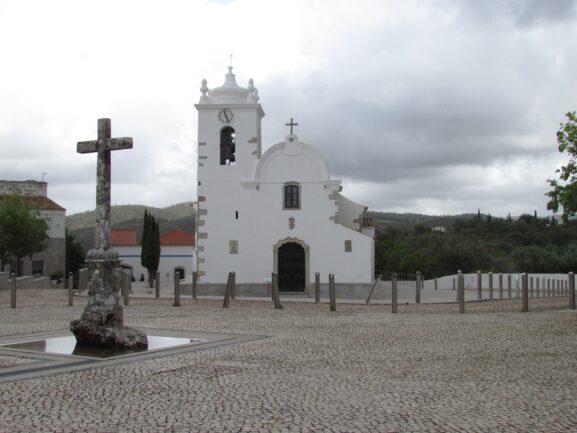
The ruins are in the civil parish of Estoi, about 2 km from the village. Estoi can be paired with the ruins for a short visit to its public streets and village church.
The pairing that works well is Milreu in the morning, followed by the short drive to Estoi village for a walk through the public streets and a look at the church. Allow around two to two and a half hours for both, depending on your pace.
Logistics and honest assessments
- Drive from Faro: Allow around 20 minutes, depending on traffic. Take the N2 toward Estoi and turn right at the Estoi junction. The road is well-signposted from the village.
- Parking: A car park at the site entrance has space for about 15 to 20 cars. Parking is generally free, but check current signs. Availability is usually not an issue, including at weekends.
- Opening hours: The usual schedule is 9am to 5:30pm from April to October and 9am to 5pm in winter, with Monday closure. Confirm current hours and closure days before visiting because seasonal changes occur and online information is not always current.
- Entry fee: The typical price is approximately EUR 3 to EUR 4, including the small onsite museum. Concessions may apply. Check locally for current pricing and eligibility.
- Time needed: Allow around 45 minutes at a comfortable pace and about 20 minutes more if you want to read all the information boards carefully.
- Crowd level: Weekday mornings are usually quiet. Weekend mornings can be slightly busier, but the site receives fewer visitors than the coastal attractions.
- Surface: Paths are firm gravel, with some uneven sections. Standard pushchairs can manage with care. The uneven terrain and steps in the bath complex make the site unsuitable for wheelchair users.
What to bring
- Comfortable shoes. You will be on your feet on uneven ground.
- A water bottle. There are no visitor facilities at the ruins.
- A hat and sunscreen. There is minimal shade on the site.
- The site plan from the entrance board. It makes the layout easier to follow.
How to fit it into a trip
Milreu works as a short standalone trip from Faro or as part of a morning itinerary that includes Estoi village. It is also a natural addition to a day on the eastern Algarve coast, including Tavira, the barrier islands and Cacela Velha. It lies on an inland route between Faro and Tavira. Allow around 45 to 60 minutes for the visit when adding it to the journey.
If you are based in Lagos or Portimao, the drive is long for a dedicated visit. If you are already spending time near Faro, Milreu is a convenient historical stop that requires little prior planning.
What this is not
Milreu is not a spectacle. There are no standing walls rising to 10 metres, reconstructed temples or dramatic restoration. What you have is a well-preserved villa floor plan, visible mosaics and enough of the infrastructure to understand how the building worked. For visitors with an interest in Roman archaeology, it offers time to read the boards and walk through the rooms without a crowd. For visitors without that interest, it may feel like a small field with some old tiles.
Honest assessment: if Roman Portugal does not interest you, this is unlikely to change your mind. If it does, or if you want to understand what people in this part of the Algarve were doing 1,700 years before the first tourist arrived, it is worth the drive.