The Pre-Summer Algarve: Why Late March and April Beat June for Walking
## The Case Against June
Here’s a truth the tourism brochures don’t lead with: June is often a worse month to walk the Algarve than late March or April.
Yes, the days are longer. Yes, the sun is reliably out. But anyone who has walked the Rota Vicentina in early June, or pushed inland on a Caldeirão ridge walk when the temperature is pushing 32°C, will tell you that summer arrives earlier than the calendar suggests. The Atlantic feels cold because it is cold — still sitting around 18°C at the surface — but the air temperature tells a different story. The thermal contrast makes the coast tolerable. The interior, on a still June afternoon, is a different proposition.
Late March and April offer something genuinely rarer: the full package. Trails in good condition. Wildflowers still going. Rivers and streams still flowing. Crowds that haven’t arrived yet. Temperatures that are actually pleasant for sustained effort.
## Temperature: What the Numbers Actually Say
| Month | Avg High (Inland) | Avg High (Coast) | Trail Walking Conditions |
|——-|——————|——————|————————|
| March | 17–20°C | 16–19°C | Excellent — cool enough for sustained effort |
| April | 19–24°C | 18–22°C | Excellent — ideal for long days |
| May | 23–27°C | 21–25°C | Good — warming but manageable |
| June | 27–32°C | 24–28°C | Marginal inland — hot for strenuous walks |
Inland areas around Silves, Monchique, and the Barrocal can already hit 30°C in late June. On a 15km trail day with no shade, that is a different kind of walking to what April delivers.
The coast is more forgiving — a sea breeze kicks in most afternoons — but the interior is where the temperature math gets uncomfortable. If your itinerary includes the Via Algarviana sectors inland, or the Silves-to-Monchique ridge walk, April is the objective answer.
## Trail Conditions: The Spring Edge
Spring rain is the Algarve’s secret walking ally. The trails that turn dusty and eroded by July are at their best in April — compact, grassy in places, water still running in the streams and spring boxes that the Rota Vicentina relies on. The wildfire risk is low. The vegetation is green. The ground holds moisture without being boggy.
By late May, some of the more southerly sectors of the Rota Vicentina start showing dry patches. The Barrocal walking routes — which rely on seasonal water sources — can have dry fountains by mid-June. April has none of these concerns.
## The Crowds Factor
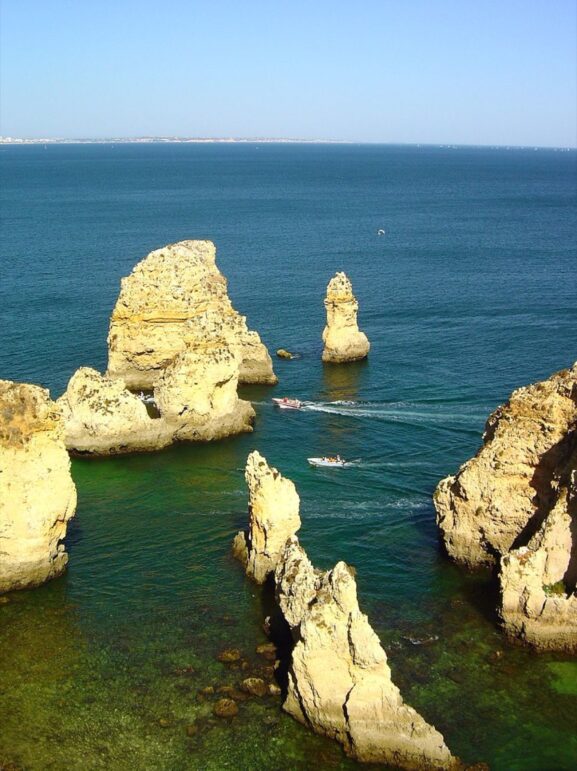
June is when the Algarve season properly opens. The resorts fill. The beaches get busy from mid-morning. The car parks at Sagres, Arrifana, and the Carrapateira cliffs start to feel like car parks. The fishermen’s trail — which is specifically about escaping that feeling — begins to see other walkers on every headland.
Easter is the main crunch point in late March or early April, depending on where Easter falls. In 2026 Easter falls in early April (Good Friday on April 3 and Easter Sunday on April 5). The week after Easter is traditionally quieter again as the domestic Spanish and Portuguese holidaymakers return home.
Late April, in a non-Easter year, is one of the quietest walking windows of the entire season. The school holidays in Portugal don’t typically overlap with late April. The foreign market hasn’t peaked yet. The trails feel different. More Portuguese. More real.
## The Water Question: Honest Assessment
The Atlantic is still cold in April. Surface water temperature at Lagos runs around 16–17°C — comfortable for a brief swim but not for the long, lazy immersions of July and August. By late May the water warms toward 18–19°C. June sits at 19–21°C on good days.
If you are primarily a walker who wants to cool off at the end of a trail, April works fine. Bring a wetsuit for swimming or accept a short dip. If you want to spend an hour bobbing in the sea after a walk, wait until July.
This is a genuine trade-off: April gives you everything else; June gives you warmer sea. Which matters more is a personal call.
## Wildflowers: April’s Secret Weapon
The bloom in the Barrocal — the limestone transitional zone between coast and interior — usually starts strongly in March and often runs through April, with local peak timing varying by rainfall and exposure. On the coastal cliffs between Lagos and Sagres, spring color is still visible in March and April before drying conditions set in.
By late April the coastal bloom is past its peak. By May the Barrocal has dried off significantly. March and April are the wildflower Algarve. June is the green-and-brown Algarve, after the bloom, before the autumn green returns.
## The Comparison: April vs June for Walking
**April wins on:**
– Temperature (ideal for sustained effort, especially inland)
– Trail conditions (water sources flowing, ground solid)
– Wildflowers (still going, especially coastal and Barrocal)
– Crowds (significantly quieter than June)
– Waterfall season (springs and waterfalls still running)
– Price (accommodation still off-peak rates)
**June wins on:**
– Sea water temperature (marginally warmer)
– Day length (slightly longer)
– Weather reliability (almost no rain)
– Infrastructure availability (full season facilities)
If you are a walker first, April is the better bet. If you are a swimmer who happens to walk, June starts to make more sense from mid-month onward.
## The Bottom Line
The argument for June rests on weather predictability and sea warmth. The argument for April rests on everything else that makes walking good: temperature, trail conditions, scenery, solitude, and price.
The Algarve’s walking season is longer than most people assume. It starts in late February and runs through to early June in most years. The sweet spot is the six-week window from mid-March to the end of April. June is fine. April is better.
The practical upside of April is not minor: flights are cheaper, accommodation is cheaper, trails are emptier, and the light is still extraordinary. You lose 45 minutes of daylight compared to June. You gain everything else.
Go in April. You will not regret it.