The Living Fishing Villages of the Algarve: Where Daily Life Still Follows the Tide
A Different Kind of Harbour
Most visitors to the Algarve arrive for the beaches and leave having barely registered that the coast is still, in places, a working coast. Tucked behind the tourist strips and the shell-door restaurants are three fishing communities where the day’s rhythm is still set by the tide, where the catch is sold before the morning mist has lifted, and where the boats go out and come back in with the same unhurried regularity they have kept for generations.
These are not curated heritage experiences. They are not museums or performances of how things used to be. Culatra, Olhão, and Tavira are functioning harbours where you can still watch a net being mended, buy sardines straight from a crate on the dock, and eat seafood that was swimming hours ago — if you know when and where to go.
Culatra: An Island Community That Moves With the Tide
Culatra is a sand island in the Ria Formosa lagoon, part of the municipality of Lagos. There are no roads connecting it to the mainland — access is by small ferry or, at low tide, by a firm-packed sand path from the mainland shore near Monte Gordo. That tidal dependency is the first thing to understand: the crossing is only reliable within a two-hour window around high water. Outside that window, the channel is too shallow. Check the tide tables before you go and plan your crossing accordingly — getting stranded on the island is inconvenient at best.
What you find on the other side is a small community of perhaps 900 people, the majority of them directly or indirectly employed by the sea. The houses are simple, the streets are sand, and the sound is always water — lapping at the dock, sloshing through the channels, creaking in the boat hulls. A few small restaurants and a café or two serve visitors, but the island has not remade itself for tourism. The fish auction happens early in the morning. The nets are stacked on the dock. The dogs sleep in the sun with the indifference of creatures who have seen everything twice.
The beach on the ocean side of the island — long, wide, and largely empty even in summer — is one of the most unspoiled in the Lagos area precisely because it requires effort to reach. Come for the morning crossing, stay for the morning, eat whatever the café has that day, and cross back when the tide allows.
Olhão: Portugal’s Largest Fishing Port
Olhão, a 20-minute drive east of Faro, is a completely different scale. By volume of catch, it is the largest fishing port in Portugal — a fact that explains both the town’s character and its relative lack of tourism polish. The harbour is busy in a way that the smaller Algarve ports are not, with dozens of boats tied up at any hour and the whole town carrying a faint permanent smell of salt, fish, and diesel that residents seem entirely comfortable with and newcomers notice immediately.
The most distinctive features of Olhão are the charcacas — tall, narrow wooden fishing huts built on stilts over the water, painted in faded primary colours, stacked in long rows along the waterfront. They date from the 19th century and are still used for storing equipment, mending nets, and sorting the catch. Walking the charcaca waterfront in the early morning, when the boats are unloading, is one of the most authentically maritime experiences the Algarve offers.
The market halls — twin modernist buildings from 1916 — sit at the head of the waterfront and are where the catch is sold retail. The daily fish market inside is where you buy directly from the boats. Arrive before 9am for the full experience. By noon most of the best produce is gone.
Olhão’s appeal is frankly industrial by Algarve standards. It is not pretty in the way that Tavira or Lagos is pretty. It is working, gritty, and real — and for that reason it rewards visitors who want to understand how the regional seafood supply chain actually functions rather than simply consuming from the finished restaurant end of it.
Tavira: The Harbour at the Eastern Edge
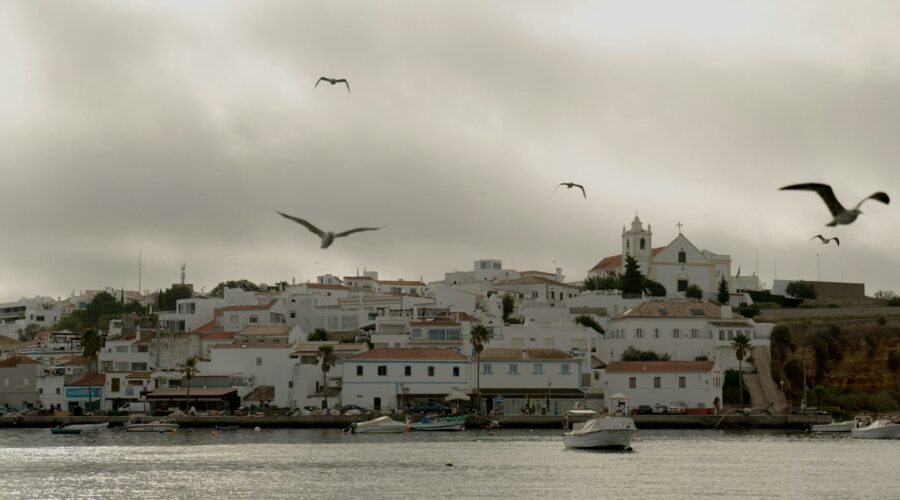
Tavira’s fishing harbour sits at the mouth of the Gilão River, where the town tapers toward the sea. It is smaller than Olhão, more compact than Culatra, and in some ways the most accessible of the three — easily walkable from the main town without needing a ferry or a car.
The quay is a working space. Fishing boats tie up alongside, and the catch is sold from the back of vans and trestle tables on the dock more often than from formal market facilities. The scale is human: you can walk the length of the active harbour in ten minutes, watch what’s being landed, talk to the fishermen if they are in a talking mood and you approach respectfully.
The salt pans behind the harbour are worth combining with a visit — they are part of the same maritime ecosystem and give a broader picture of how the coast has been used and harvested for centuries. The bridge across to the beach island of Terra Estrecha is a pleasant walk and opens up the wider Ria Formosa eastern system.
Tavira itself is one of the more handsome eastern Algarve towns, with a Roman bridge and a ruined castle, so a harbour visit pairs naturally with a morning or afternoon in the town proper.
The Rhythm of the Tide
What unites these three places is not their scale or their character — those differ considerably — but their underlying dependency on the tidal schedule. Fishing trips are planned around tide times. The boats go out on the flood and return on the ebb. The markets open when the boats land. Everything in a tidal harbour has windows, and those windows are not flexible.
For the visitor, this means that timing matters. A harbour at 2pm on a Tuesday may be completely inactive — the boats have gone out, the market has sold through, the dock is quiet. The same harbour at 8am on a Wednesday may be vibrant with activity. Before making a visit a centrepiece of your day, check both the tide times (for Culatra) and the rough local landing hours. Morning is reliably better than afternoon across all three.
This is not a inconvenience. It is, if you slow down enough to notice, part of what makes these places different from everywhere else. The sea sets the schedule. You work around it.
Visiting Well
These communities have varying relationships with visitors, and that relationship is worth approaching thoughtfully.
At Culatra, you are a guest on a small island where strangers are noticed. Walk quietly. Don’t block the dock when boats are landing. The island’s limited facilities are for residents first. The crossing requires planning — don’t attempt it without checking tide times, and be aware that the ferry service can be irregular outside summer months.
At Olhão, the harbour is public and the market is a public market. Treat it as such. The town has a lived-in character and is not performing tourism. You are welcome to watch, to buy, to ask questions — but be aware that this is a working neighbourhood, not a heritage attraction. Photography of people and boats without asking is poor form.
At Tavira, the small scale means you will stand out more. The harbour is right next to the town centre and sees a mix of locals and visitors in a way that feels less specialised than Olhão or Culatra. It is perhaps the most straightforward of the three to visit independently.
What all three share is the opportunity to experience something that the Algarve’s tourism industry has, in most places, thoroughly gentrified out of: a working maritime economy where the product is seafood, the schedule is tidal, and the visitor is genuinely secondary to the work at hand. That is the thing worth protecting — and worth experiencing — while it still exists.
The broader context is worth naming: these communities face real pressures. Fishing quotas, rising operating costs, younger generations drifting toward tourism employment, and the encroachment of coastal development on traditional working waterfronts are challenges felt across all three harbours. Olhão’s charcacas have been the subject of preservation debates for years. Culatra’s island access infrastructure is perpetually underfunded. Tavira’s small-scale fishermen compete with larger operations and with the region’s growing aquaculture sector. These are not static heritage exhibits — they are living economic communities navigating the same forces that have reshaped coastal life across Europe. Visiting them honestly means seeing that complexity, not just the picturesque surface.
The reward for doing so is real and specific: a morning watching the boats come in at Olhão, the stillness of Culatra in the off-season, the small daily commerce of Tavira’s dock. These are experiences that require nothing more than showing up at the right time, with a little patience and no expectations of being catered to. In a region that has become very skilled at performing authenticity, that is genuinely unusual.