Ancient Trees of the Algarve: The Centuries-Old Sentinels of the Barrocal
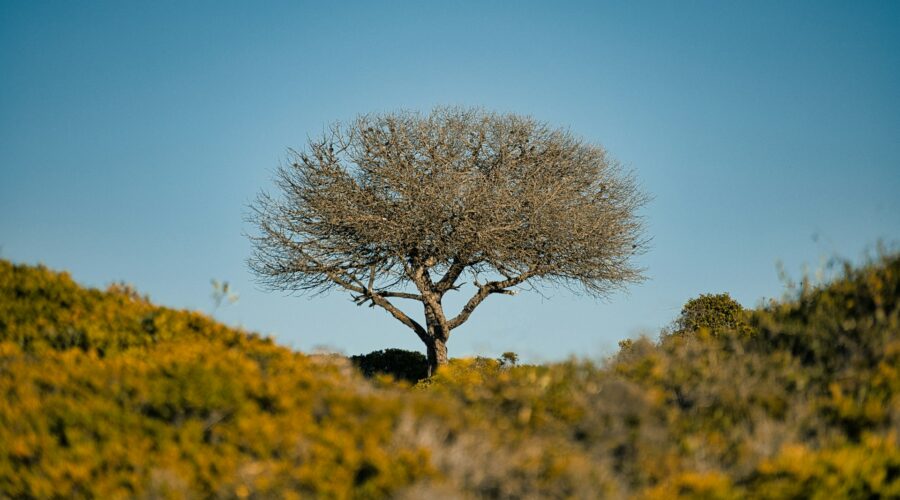
The carob tree outside the chapel in Cachoupe looks like something from a mythology book — trunk gnarled into a mass of dark furrows, branches reaching out over the ancient stone walls with the unhurried confidence of something that has outlasted every drought, every fire, every generation of farmers who once gathered beneath it. It is not unusual. In the Barrocal zone of the Algarve, trees like this are common. Dozens of them. Hundreds, perhaps. The problem is that nobody thinks to look.
The Barrocal is the transition band between the coastal lowlands and the schist hills of the Serra. Geologically it is a limestone shelf — a shelf that holds moisture differently than the sandstone above and the sand below, creating conditions that have supported a silvopastoral landscape for at least two thousand years. The ancient olive trees, the centenary carobs, the knotted almond trees that bloom white in February — they grow here not by accident but by design. The farmers who shaped this landscape understood that scattered trees in pasture produced better yields, better soil, better livestock. The trees remained when the farmers left.
Why Ancient Trees Survive Here
The Barrocal’s limestone walls — the murhas and cercas that divide smallholdings — were built by hand, stone by stone, across centuries. The walls served as animal enclosures and boundary markers, but they also created micro-shelters for tree seedlings. A carob seed dropped by a bird or a farm animal would germinate in the shade and shelter of a wall, establishing roots deep enough to survive the summer droughts that make the coastal strips unreliable for this kind of growth.
The land here also worked differently under traditional farming. Goats and sheep grazed beneath the canopy, keeping competing vegetation low without compacting the soil as heavily as modern machinery. The trees benefited from the manure, the pruning of lower branches for fodder, the periodic fire clearing that removed scrub but left mature trees untouched because farmers valued them too much. This is agrosilvopastoralism — a farming system so old it has no precise start date — and it produced exactly the conditions that ancient trees need: space, light, nitrogen-rich soil, and continuity of tenure across generations.
What changed was the exodus from the land. When the children of smallholders moved to the towns in the 1960s and 1970s, the grazing stopped. The walls began to crumble. And the trees — relieved of their role but still standing — became invisible to everyone except the occasional walker who stopped, looked up, and wondered.
What to Look For: Species and Scale
Carob trees (Ceratonia siliqua) are the dominant ancients of the Barrocal. The oldest carobs can live for over 500 years, their trunks expanding into forms that look more geological than botanical. Look for the multiple-stemmed specimens — the result of centuries of coppicing, where farmers cut the tree back to stimulate new growth and fresh pods. A single ancient caroc tree that appears to be three or four trees is usually one tree with a very long history.
Ancient olives (Olea europaea) are harder to find in the Barrocal because most olive groves were cleared for intensification, but the ones that remain along the older property boundaries are extraordinary — spiral trunks, grey-green foliage, fruit that appears in autumn. The village of São Brás de Mexelóm has a documented ancient olive at its edge that local residents estimate at over 400 years old, growing in what was once the village common.
Almond trees (Prunus dulcis) bloom in February, turning the Barrocal hillsides white for a few weeks. The ancient almond trees are the ones that survived because they were planted as boundary markers and are therefore less likely to have been grubbed up during agricultural intensification. The almond bloom is the easiest time to find them.
Cork oaks (Quercus suber) appear at the transition between Barrocal and Serra, where the limestone gives way to schist. The oldest cork oaks in the region are found in the Castro Marim and Caldeirão area, where the herdade (large estate) structure preserved the landscape better than the fragmented smallholding pattern of the central Barrocal.
Finding Them: Practical Access
The ancient trees of the Barrocal are not signposted. There are no roteiros or dedicated trails. Finding them requires two things: limestone walls (which mark the old smallholdings) and walking between villages rather than through them.
The most reliable area is the Cachoupe — Vicosa — Mealha circuit, a network of rural lanes and footpaths between the EN270 and the M523 road south of São Brás de Mexelóm. Park at the small square in Cachoupe (there is space for three or four cars near the chapel), and walk the lanes east toward Vicosa. The ancient carobs are on the smallholding walls to either side of the lane, marked by the characteristic low stone walls and the density of old trees in a pattern too deliberate to be natural.
Parking: Small lay-by at Cachoupe chapel. No facilities. The road is passable for all vehicles in dry weather; in wet weather the limestone lanes can become slippery.
Best season: February for almond blossom. October for carob harvest — you may see farmers gathering pods, a reminder that some of these trees are still working trees.
What to bring: Water. The walks are unshaded in summer. Sturdy shoes for the uneven limestone lanes.
The Question of Conservation
Most of the ancient trees of the Barrocal are on private land. The landowners are often absentee — descendants of the families who farmed here — and the trees survive because clearing them would cost more than they are worth economically. This is an unstable equilibrium. As land changes hands, as properties are sold for rural tourism development or simply absorbed into larger holdings, ancient trees are sometimes lost. The Castro Marim municipality has begun a survey of ancient trees on public land, but the Barrocal zone outside protected areas has limited formal protection.
What this means for walkers: these trees are a finite and non-renewable resource. They should not be climbed, have their bark touched, or be used as anchor points for hammocks or slacklines. The limestone walls are equally old and equally fragile. The landscape is more vulnerable than it looks.
A Note on Timing
The Barrocal is not a wilderness. It is a cultural landscape that is slowly losing the culture that maintained it. The ancient trees are the relics of a working landscape — a system of land use that sustained rural communities in this part of the Algarve for centuries before those communities left. Walking through the lanes and finding a 400-year-old carob still producing pods in October is not a natural occurrence. It is a human one, decades in the making. The trees are worth knowing, and they are worth keeping.