The Spring Light of the Algarve: Why Photographers Are Discovering the Coast in March and April
The Light That Summer Loses
There is a particular quality of light on the Algarve coast that you will not find in July or August — no matter how golden the travel brochures make those long summer days look. It arrives in late March and lingers through April: a soft, angled illumination that the Atlantic atmosphere refracts and deepens, turning ordinary cliff faces into sculptures and ordinary tide pools into sheets of liquid copper.
In summer, the sun sits high and harsh overhead almost from mid-morning onward. Shadows collapse beneath subjects. The light is flat, bleached, and contrasty — technically demanding and visually exhausting. In late March and April, the sun runs on a lower arc. It rises in the east over the Ria Formosa lagoons around 06:20 and sets in the west near Cabo de São Vicente around 18:50. That lower trajectory means longer shadows, warmer colour temperatures, and light that arrives at an angle the eye finds inherently beautiful. Add the residual Atlantic moisture in the air — not the haze of high summer, but a gentle atmospheric depth — and you have conditions that photographers travel to Iceland or Namibia to find, sitting right here on Europe’s southwestern edge.
This is the overlooked window. Most photography-focused visitors arrive in May or June, drawn by the longer days and warmer weather. They find good light. They miss the best light.
The Light in Spring
Why March and April Are Different
The physics are straightforward. The Algarve sits at roughly 37° north latitude. In late March, the sun’s angle at solar noon is about 52° above the horizon — a far more flattering angle for landscape work than the 70–75° of midsummer. By mid-April it climbs to around 58°, still comfortable. At these angles, light travels through more atmosphere before reaching the ground, scattering the blue wavelengths and enriching the reds and oranges. Shadows stretch out at dramatic lengths, defining texture in limestone cliff faces that summer sun simply flattens.
The Atlantic moisture plays a subtle but crucial role. A shallow marine layer often persists through March and early April, especially on the south-facing coast. On clear mornings this manifests not as cloud cover but as atmospheric haze — a gentle veil that softens contrast, adds depth to distant headlands, and gives the sky a luminosity that pure desert air cannot replicate. The result is a three-dimensional quality to coastal scenes: near rocks in sharp detail, middle distance in rich midtone, far cliffs dissolving gently into atmospheric blue.
The Best Times of Day
Dawn is the secret weapon of spring photography on the Algarve. At 06:00 in late March, the coast is utterly empty. The south-facing cliffs around Lagos and Sagres catch the first colour as the eastern sky lightens — deep rose and amber reflected in tide-washed rock before the sun clears the horizon. The temperature is cool, the wind is usually light, and you will likely have iconic locations like Ponta da Piedade or the cliffs above Praia do Camilo entirely to yourself.
For the late afternoon golden hour, the west coast becomes your canvas. The stretch between Odeceixe and Cabo de São Vicente runs roughly east-west, which means the setting sun runs parallel to the shoreline in spring. At 17:30 in mid-April, the light comes in side-on to the cliffs at Carrapateira, providing the raking illumination that makes limestone textures extraordinary. The further west you are, the more of this golden side-light you capture.
On the south coast, the golden hour is more front-on in spring, which lends itself to a different quality: the flat reflecting surfaces of tide-washed rock and wet sand multiply the warm tones. Praias do Camilo and do Barranco are particularly effective at this time — the rock stacks catch the warm light while the tidal pools return a mirror image.
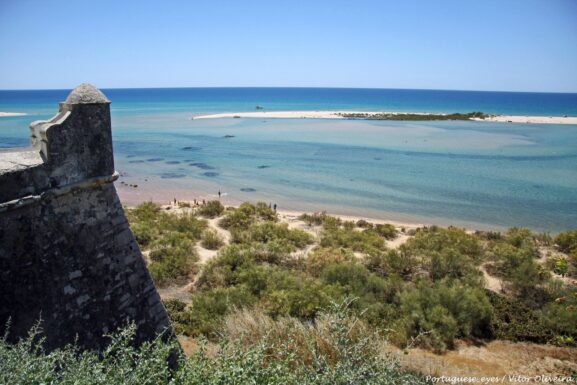
Checking precise sunrise and sunset times for your specific location is always worth doing. In Lagos, late March sunrise is around 06:20 and sunset around 18:45. At Sagres, both are about ten minutes later. Along the Ria Formosa near Tavira, the sunrise light plays across open water in a way that is entirely different from the cliff-bound coast — longer, flatter, and more contemplative.
The Perfect Palette
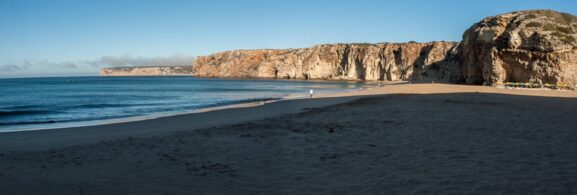
One of the overlooked gifts of spring on the Algarve is the colour contrast available within a single frame. The winter and early spring rains — more abundant in 2025–26 — have left the hillsides unusually green. The cork oak forests of the Barrocal zone are in fresh leaf, a soft silvery green quite different from the dusty olive of summer. Below the cliffs, the Atlantic runs from steel blue in deep water to turquoise in the shallows, with tide pools catching the sky colour. The limestone cliffs themselves range from chalky white to warm cream, and where they have been oxidised by seawater they take on warm orange and rust tones.
This green-blue-white-orange palette is one of the most naturally harmonious in European coastal photography. You do not need to work hard to get good colour balance in spring. The landscape is doing it for you.
What to Photograph
Coastal Cliffs at Dawn
Ponta da Piedade, just south of Lagos, is one of the most photographed landmarks in southern Portugal — and one of the least interesting at noon in August when every angle is harsh and busy with boats. At 06:30 in late March, it is a different place. The sea stacks and arches are lit from behind by the rising glow, and the tide pools in the foreground catch the colour. The angle of the light at this time of year runs almost parallel to the cave systems, drawing warm highlight across the rock faces while the shadows remain detailed and readable.
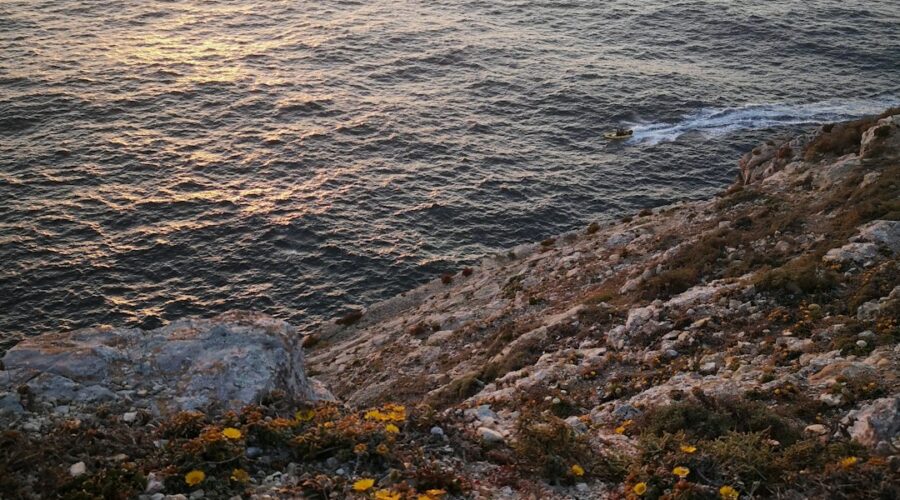
Further west, the cliffs between Cabo de São Vicente and the lighthouse are dramatic in a different way — rawer, more exposed, with the Atlantic stretching to the horizon. The lighthouse itself, bleach-white against the deep blue sky, works best in spring with the wildflowers that still cling to the clifftop grasses in late March. The path along the cliff edge is easiest in these months, when the summer’s trampled dust has been refreshed by winter rain.
Wildflower Carpets on the Clifftops
The Rota Vicentina/Fishermen’s Trail runs 240 kilometres along the western coast of the Algarve and into the Alentejo. In late March and early April, the cliff-top paths between Pedralva and Odeceixe pass through corridors of wild vegetation that most summer walkers never see at its best. Purple vetch, yellow marigold, white chamomile, and the brilliant red of field poppies carpet the ground on either side of the trail. In the morning light, with a long lens and the Atlantic as a clean blue backdrop, these corridors become vivid colour studies.
The wildflowers are at their most intense in early to mid-April. The poppies tend to peak first — late March into early April. The chamomile and vetch follow and last slightly longer. A walk along the clifftop section between Prairie de Amado and Carrapateira in the first week of April will typically offer all three in quantity.
The Ria Formosa at Sunrise
The Ria Formosa lagoon system, stretching from Faro to Tavira, is one of the Algarve’s most important wetlands — and one of its most photographed. But the lagoon rewards a very specific time: the first hour after sunrise, when the light comes from behind you across the open water and the flamingos, spoonbills, and herons that populate the shallows are most active.
In late March, the sun rises over the eastern edge of the lagoon near Tavira, turning the water into a reflecting surface of gold and rose. The salt pans on the inner edge of the lagoon catch this light differently from the open water — shallower, calmer, with more colour saturation. The birdlife is at its winter-spring peak in March and early April before many species head north to breed. This is arguably the finest hour for lagoon photography in the entire year.
Cork Oak Forests in Soft Side-Light
Twenty minutes inland from the coast, the landscape shifts dramatically. The Barrocal zone — the transitional hills between the coastal plain and the Serra de Monchique — is characterised by its cork oak forests. In spring, the oaks are in fresh leaf, the bark is at its richest red-brown tone, and the acanthus and rock rose grow thick along the forest floor. The filtered light of a spring afternoon, coming through the canopy at an angle, turns the forest floor into a study in green and shadow.
The light quality inside these forests in April is unlike anything the coast offers: soft, diffused, without the harsh contrast of a midsummer midday. Photographers who focus exclusively on the coast are missing half the photographic potential of the region. Villages like Bordeira, well inland from the south coast, offer easy access to cork oak terrain and quiet country lanes that work beautifully in the magic hour.
Street Scenes in Quiet Villages
Spring in the Algarve’s interior villages is a study in the relationship between light and built form. Villages like Aljezur, Cercal do Alentejo, or the small hill settlements above the west coast have whitewashed walls that are at their cleanest and brightest in spring, before the summer dust settles and the harsh sun bleaches everything to the same flat white. In the early morning or the last hour of daylight, these walls become reflectors, bouncing warm light into the narrow streets.
The café culture of these villages — unhurried, authentic, entirely unperformed — also offers genuine street photography material. Locals at a morning coffee, the light falling across a ceramic-tile facade, the shadow of a wrought-iron balcony across a cobbled street. These scenes are harder to find in summer when the villages fill with visitors and the light is less interesting.
Practical Notes
Weather Considerations
Spring weather on the Algarve is more variable than summer — and this variability is part of what makes the photography interesting. A clear morning after a night of light Atlantic rain can produce the most extraordinary atmospheric conditions: high clouds catching pre-dawn colour, moist air adding depth to distant views, and the chance of dramatic cloud formations over the sea.
The Portuguese Institute of the Sea and Atmosphere (IPMA) publishes reliable three-day forecasts that include cloud cover and visibility estimates — worth checking before a planned dawn shoot. A passing weather front, which might deter a beach-goer, can produce the best photography conditions of the entire spring window.
Cliff Edge Safety
Many of the best photography locations — Ponta da Piedade, Cabo de São Vicente, the clifftop paths near Carrapateira — involve standing close to unprotected cliff edges. In spring, cliff-edge vegetation is often wet and the paths can be muddy. The same Atlantic that creates the beautiful light can generate sudden gusts of wind on exposed headlands. Sturdy footwear with good grip, attention to the path underfoot rather than the view through the viewfinder, and a simple rule of never turning your back to the edge are the basic precautions. The light will still be there in ten minutes — the cliff will not wait if you get too close.
Recommended Approach
A practical setup for spring coastal photography in the Algarve: a wide-angle lens for the cliff and coastal panoramas (16–35mm full-frame equivalent), a standard zoom covering 24–70mm for more general work, and a longer telephoto for compressing distance on the coastal sections and for picking out details in the wildflower carpets. A polarising filter is useful for cutting glare on wet rock and deepening the blue of the Atlantic sky. A small, sturdy tripod opens up the low-light possibilities of early morning and late afternoon.
What to wear: layers. The pre-dawn temperature in late March can be below 10°C with a wind off the Atlantic. By mid-morning in April it can be above 20°C. You will be standing still for long periods at dawn and dusk — warm layers that can be peeled off as the morning warms are essential.
Respecting the Landscape
The Rota Vicentina trails and the Natural Park zones of the Ria Formosa and the west coast clifftops are protected landscapes. The wildflower meadows and cliff-top grasslands are fragile ecosystems that recover slowly from heavy foot traffic outside the established paths. Stick to waymarked trails, particularly in the dune and grassland sections. Do not move stones or disturb the salt-pan structures in the Ria Formosa. If you are photographing in or near village squares, be respectful of the fact that these are lived-in spaces — a telephoto lens allows you to capture street scenes without intruding on them.
The Window That Closes
Late March and early April represent something genuinely rare in the Algarve photography calendar: a moment when the landscape is at its most visually rich — green hills, wildflower carpets, dramatic Atlantic light — and almost entirely uncrowded. The summer visitors have not yet arrived. The tourism infrastructure is awake but not overwhelmed. The light is extraordinary by any measure.
May will bring longer days and more reliability. It will also bring more people, higher sun angles, and the beginning of the dry-season flattening that reduces the visual richness of the vegetation. April closes. The cork oaks will still be green in May, but the poppies will be gone. The cliff-top flowers will be seed. The atmospheric depth of a spring Atlantic morning is a seasonal thing.
If you have been thinking about the Algarve as a summer destination, think again. March 20th is here. The window is open. The light is already different.
Photo opportunities mentioned in this guide are natural features of the Algarve landscape — no commercial relationships or affiliate arrangements are associated with any location mentioned.