The April Night Sky: Stargazing in the Algarve When the Clouds Clear
Most visitors to the Algarve never see the stars. They’re too busy with dinner, too tired from the beach, or staying in light-polluted resort areas. But away from the coast, in the dark interior valleys and elevated plateaus, the April sky reveals something most Europeans have never witnessed: a sky so full of stars it feels like falling upward.
Why April Stargazing Differs from Winter
Winter skies offer the Orion constellation and crisp, steady seeing. April skies offer something different: the summer Milky Way rising in the east, warmer nights that don’t require heavy layers, and a celestial landscape that shifts noticeably each week.
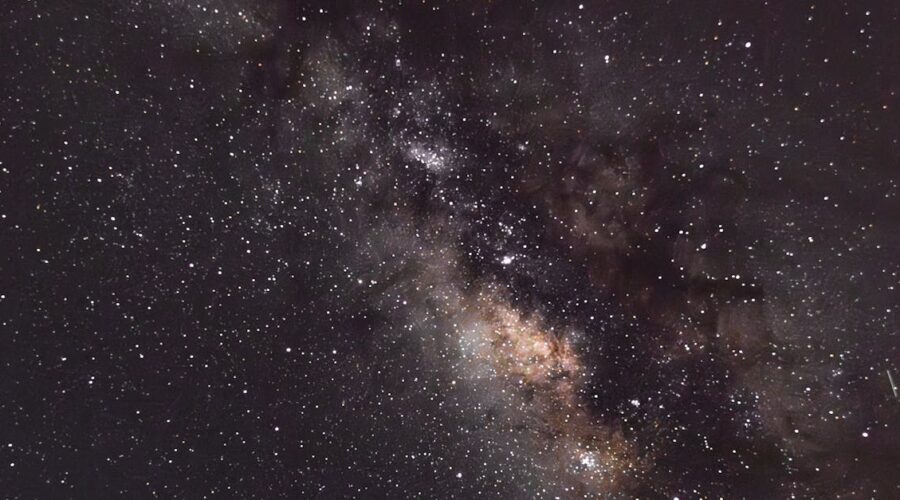
The key difference is the galactic core. By late April, the brightest part of the Milky Way — the region toward the galactic center in Sagittarius — begins to rise above the horizon after midnight. This means April marks the transition from winter deep-sky observing to summer Milky Way photography.
Best April Stargazing Locations
Cerro da Cabeça (Aljezur)
The hilltop above Aljezur offers elevation and distance from village lights. The 360-degree horizon means you can watch the Milky Way rise over the Atlantic to the south and west. The summit is reachable by a 30-minute walk from the parking area.
Practical: Dark, unlit road. Bring a red-light headlamp to preserve night vision. Best nights: any cloud-free evening after 10 PM.
Rota Vicentina Trail (Odeceixe to Zambujeira)
The inland sections of the Fishermen’s Trail and Via Vicentina pass through some of the darkest territory in southern Portugal. The coastal plain, free from nearby towns, offers remarkable darkness. Walk a short distance from any trailhead parking area and look up.
Practical: No facilities. Bring water and a flashlight. Best combined with a day hike — camp or stay in local accommodations.
Monchique Foia Plateau
While the immediate area around the Foia summit has some light pollution from the restaurant/parking area, the surrounding hillsides offer excellent views. The elevated position above the coastal haze means clearer seeing, especially toward the zenith.
Practical: Drive past the main Foia parking to smaller pull-offs on the southern approach road. Best after the restaurant closes (around 10 PM).
Alcoutim Countryside
The remote northeastern corner of the Algarve, far from any significant towns, offers some of the darkest skies in the region. The Guadiana Valley below provides a natural light sink, and the few village lights are minimal.
Practical: Combine with a day visit to Alcoutim. The village has one small hotel and a restaurant. Best viewed from the castle hilltop.
What to See in April
The Milky Way
By mid-April, the galactic core rises around 1-2 AM in the southeast. By month’s end, it’s visible as early as midnight. Look for a faint band of light stretching from Sagittarius (low in the south) through Scorpius and up toward Cygnus in the northeast. The brightest section, near the “teapot” of Sagittarius, is the galactic center.
Jupiter and Saturn
Jupiter dominates the evening sky in early April, visible in the west after sunset. Saturn rises around 3-4 AM in the east, with the ring system increasingly tilted toward Earth — ideal for telescope viewing.
The Hyades and Pleiades
The V-shaped Hyades cluster in Taurus remains prominent in the western evening sky, with the smaller Pleiades (Seven Sisters) nearby. Both are easily visible to the naked eye and spectacular in binoculars.
Lyrids Meteor Shower (Peak ~April 22)
The annual Lyrids meteor shower peaks around April 22, producing up to 18 meteors per hour at peak. While not as dramatic as August’s Perseids, the Lyrids often include bright fireballs. Best viewing is after midnight, when the radiant in Lyra rises high in the sky.
Photography Tips
April conditions are ideal for night sky photography in the Algarve:
- Temperature — Clear April nights hover around 12-15°C, cold enough for comfortable extended sessions but not requiring heavy winter gear
- Humidity — Lower than winter months, reducing atmospheric haze
- Moon — April’s new moon falls on April 11, providing dark skies for the first half of the month. Full moon (April 26) lights the landscape beautifully for moonlit shots
- Cloud patterns — April’s variable weather means check the forecast hourly. Clear evenings often feature thin high clouds that add drama to time-lapses
Equipment Recommendations
You don’t need much to enjoy the April Algarve night sky:
- Red-light headlamp — Essential for setting up gear without destroying night vision
- Warm layers — Even 15°C feels cold when standing still for an hour
- Tripod — Essential for any photography
- Wide-angle lens — f/2.8 or faster ideal for Milky Way shots
- Binoculars — Even inexpensive 10x50s reveal thousands of stars invisible to the naked eye
Safety and Logistics
- Never walk trails at night — Stick to vehicle-accessible locations
- Tell someone your plans — Even a text message can be lifesaving if something goes wrong
- Check weather obsessively — April weather changes rapidly
- Bring a phone charger — Don’t rely on phone GPS for navigation
The Experience
Standing on an elevated Algarve hillside in late April, watching the Milky Way rise over the dark silhouette of coastal cliffs, you understand why ancient peoples built temples to the sky. The light you see left the galactic center 25,000 years ago. It traveled through the void, past millions of stars, to arrive in your eyes on a warm April night in southern Portugal.
This is the Algarve’s other wilderness. It costs nothing. It requires no equipment beyond your eyes and a dark sky. And it’s waiting every clear night.