The Algarve’s Tunnel Beaches: A Practical Guide to Accessing Beaches Through Hand-Carved Rock
Photo: Portuguese_eyes · Flickr · CC BY-SA 2.0
The Algarve’s Tunnel Beaches: A Practical Guide to Accessing Beaches Through Hand-Carved Rock
Several Algarve beaches and coves are reached through rock passages or by steep cliff paths. Access conditions vary, and some routes become unsafe when the tide rises or the sea is rough.
This guide covers five coastal locations, what to expect at each one, and the practical checks to make before setting out.
Why Rock Passages Exist Here
The Algarve’s limestone cliffs contain natural openings and hand-carved passages. Some lead to pocket beaches, while others connect coves separated by rock.
Tool marks can be visible in the hand-carved tunnels. Some limestone walls also contain visible fossils.
What you need to know before you go:
- Check the tide and sea conditions before entering any passage or confined cove.
- Do not enter a tunnel when waves or rising water could block the exit.
- Plan as if there are no facilities, lifeguards or reliable mobile coverage.
- Turn back if an access path is closed, unstable or difficult to identify.
Praia do Carvalho: The Established Tunnel Beach
Location: Lagoa municipality, near Carvoeiro and Benagil
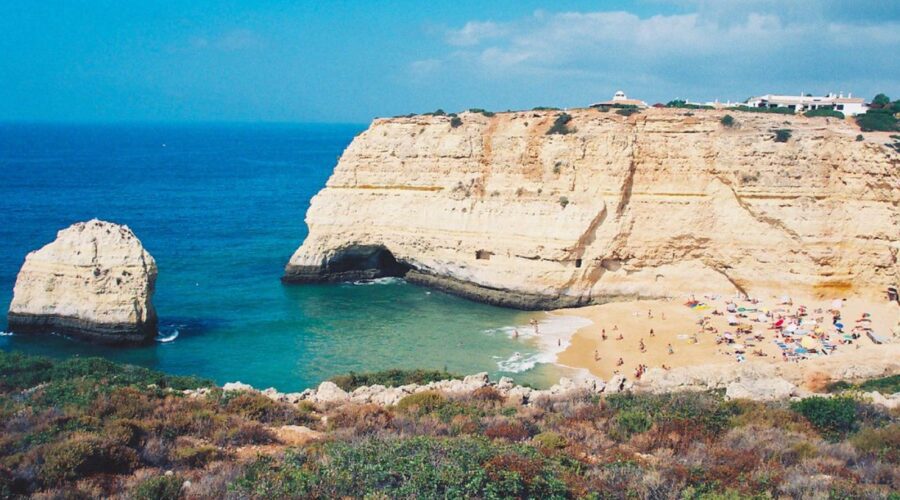
Praia do Carvalho is reached through a hand-carved tunnel in the limestone cliff. The passage opens directly onto a small sand cove backed by high cliffs.
How to get there
- Use legal public parking near the upper beach access and follow local signs.
- Do not block residential entrances or access roads.
- Walk to the marked tunnel entrance from the upper access.
- The tunnel is above the normal waterline, but the amount of usable beach changes with the tide.
What to expect
- The limestone walls contain visible details, including possible fossils and tool marks.
- The beach is small and loses space as the tide rises.
- Rocky sections can be slippery.
Crowd assessment: Space is limited, particularly during summer mornings and afternoons. An early arrival can make parking and beach access easier, but quiet conditions are not guaranteed.
Practical notes: Bring water and sun protection. Wear footwear with enough grip for damp stone and uneven rock.
Praia dos Estudantes: The Cliff Passage and Stone Bridge
Location: Lagos municipality, near central Lagos
Praia dos Estudantes has a short cliff passage connecting adjoining sections of beach. A stone bridge spans the gap between two cliff sections. It should not be confused with a natural rock arch or Roman construction.
How to get there
- Use legal public parking in Lagos and follow local beach signs.
- Check posted parking restrictions and current charges locally.
- Once on the beach, identify the passage before the tide begins to rise.
- Do not enter if waves are reaching the passage or reducing the return route.
What to expect
- The passage connects a main beach area with a smaller section.
- The stone bridge is visible between the cliffs.
- Layered limestone is exposed along the cliff faces.
- Usable beach space decreases as the tide rises.
Crowd assessment: The beach can become busy during summer and on weekends. The smaller section may receive fewer visitors, but it should not be treated as secluded.
Practical notes: Wet rock can be slippery. Follow lifeguard instructions where lifeguards are present, and do not swim outside safe conditions.
Praia João de Arens: The Narrow Rock Passage
Location: Portimão municipality, near Praia do Alemão
Praia João de Arens is divided by rock formations, with a narrow passage connecting beach sections when the tide and sea conditions permit. The route is confined and may be difficult to identify from a distance.
How to get there
- Use legal public parking near Praia do Alemão.
- Follow established coastal paths and obey closures or warning signs.
- Use only a clearly established descent to the beach.
- Attempt the connecting passage only when there is ample exposed ground and a safe return window.
What to expect
- The passage is narrow and may require bending.
- The adjoining cove has no dependable services.
- Caves and overhangs are visible in the surrounding limestone.
Crowd assessment: Visitor levels vary with the season, tide and condition of the access paths. Do not rely on the beach being empty.
Practical notes: This route is unsuitable for anyone uncomfortable in confined spaces. Do not enter if the tide is rising, waves are reaching the opening or the return route is uncertain. Carry water and suitable footwear.
Arco de Albandeira: The Sea Arch
Location: Lagoa municipality, near Praia de Albandeira
Arco de Albandeira is a sea arch rather than a tunnel beach. It is included because it can be viewed from the adjoining coastal area without entering a boat.
How to get there
- Use legal public parking near Praia de Albandeira and follow the established beach access.
- Check local signs before approaching exposed rock.
- At lower tide, more of the rocky shoreline may be visible.
- Do not climb onto the arch or cross wet rock when waves can reach the route.
What to expect
- The arch is visible from the surrounding shore and coastal viewpoints.
- The amount of exposed rock changes with the tide.
- Wet limestone can be slippery and uneven.
Crowd assessment: The beach and nearby viewpoints can become busy in summer. Visit outside the busiest part of the day if you want more room, but do not assume the site will be quiet.
Practical notes: Treat the arch as a feature to view, not a walking platform. Keep back from cliff edges and avoid exposed rock during rough sea conditions.
Praia das Fontainhas: The Small Cliff Cove
Location: Lagoa municipality, near Praia de Albandeira
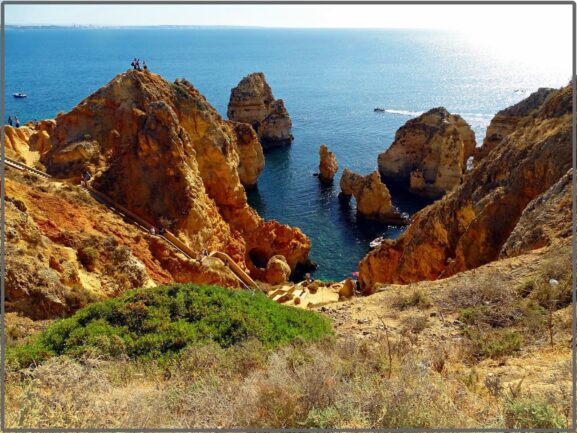
Praia das Fontainhas is a small cove below steep cliffs. It does not have a tunnel, and the descent can be narrow, loose or difficult to identify.
How to get there
- Approach only by an established coastal path that is open to the public.
- Use legal public parking near Praia de Albandeira.
- Do not use an unmarked descent if the route is unstable, overgrown or unclear.
- Turn back if access has been closed or damaged.
What to expect
- The cove is small and enclosed by cliffs.
- Beach space is limited and can shrink with the tide.
- There are no dependable facilities at the cove.
Crowd assessment: The cove’s limited space matters more than the number of visitors. If the beach is already occupied or the return route is narrowing, choose another public beach.
Practical notes: Wear footwear suitable for loose ground and uneven steps. Avoid standing beneath unstable cliff faces, and do not descend when the route is wet or damaged.
Comparison Table
| Location | Access type | Tide consideration | Parking | Difficulty |
|---|---|---|---|---|
| Praia do Carvalho | Hand-carved tunnel | Beach space changes with tide | Legal public parking near upper access | Easy, with steps and damp rock |
| Praia dos Estudantes | Cliff passage | Check passage and return route | Public parking in Lagos | Easy to moderate |
| Praia João de Arens | Narrow rock passage | Low water and calm sea required | Public parking near Praia do Alemão | Moderate to hard |
| Arco de Albandeira | Sea arch viewed from shore | Exposed rock changes with tide | Public parking near Praia de Albandeira | Easy to moderate |
| Praia das Fontainhas | Steep cliff path | Check beach space and return route | Public parking near Praia de Albandeira | Moderate |
Decision Guide: Which One Fits Your Visit
For the clearest tunnel access: Choose Praia do Carvalho. The tunnel is established, although the steps and damp rock still require care.
For a cliff passage near an urban centre: Choose Praia dos Estudantes. Parking restrictions and available beach space should be checked on arrival.
For a more demanding route: Consider Praia João de Arens only when the access path, tide and sea conditions are suitable.
For viewing a sea arch from land: Choose Arco de Albandeira. Stay on established access and do not climb onto the arch.
For a small cove: Consider Praia das Fontainhas only if the public descent is clearly open and stable.
Timing and Tides: The Main Access Check
Low tide can increase usable beach space and reveal passages, but tide height alone does not make an access route safe. Swell, wind, recent cliff falls and the speed of the incoming tide also matter.
Check a current tide table and local sea forecast on the day of your visit. Leave confined coves and passages well before rising water begins to restrict the return route.
If water is already reaching a tunnel, narrow passage or rock causeway, do not enter. Conditions can change before the next predicted high tide.
What to Bring
- Footwear with grip: Passages and approaches can be wet, rocky and slippery.
- Water: Do not depend on facilities being available.
- Current tide information: Check it before setting out and again before entering a confined route.
- Sun protection: Shade is limited and changes during the day.
- A charged phone: Mobile coverage may be unreliable below cliffs, so save essential information before leaving.
Summary
Praia do Carvalho provides the clearest established tunnel access. Praia dos Estudantes combines a short cliff passage with a stone bridge. Praia João de Arens requires more caution because its passage and approach depend on conditions. Arco de Albandeira is best treated as a sea arch to view from established ground. Praia das Fontainhas should be attempted only when its public access is visibly open and stable.
Check the tide and sea conditions, use legal public access, wear suitable footwear and turn back when the return route is uncertain.