
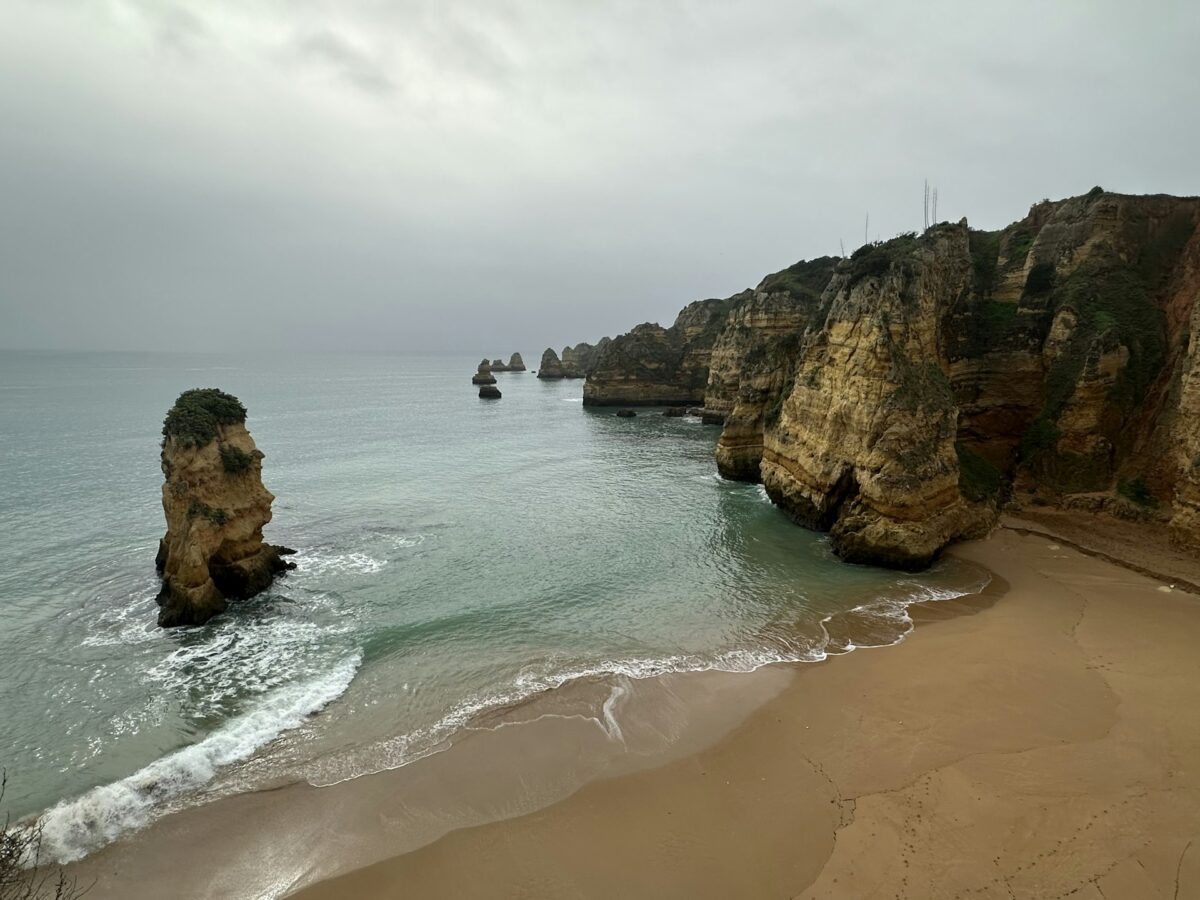
Praia do Poente sits at the far western edge of the Lagos bay system, tucked beneath ochre-red cliffs that give it a distinctly different feel from its more famous neighbours. Where Camilo, Luz, and the celebrated coves of Ponta da Piedade draw the bulk of visitor attention, Poente keeps a lower profile. It is the smallest of Lagos’s bay beaches, and arguably the one with the most character: a compact stretch of fine golden sand cupped by low cliffs, with rock formations at both ends creating natural corridors into and out of the water.
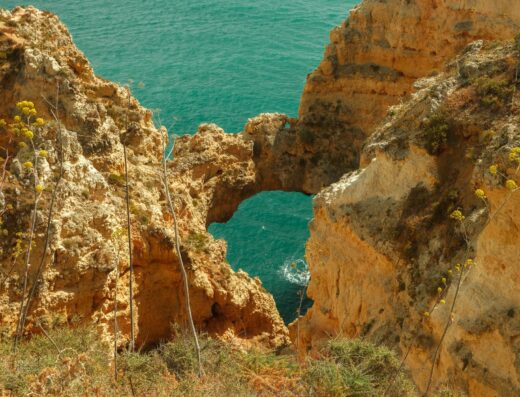
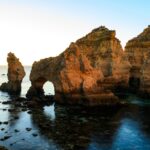
The cliffs here are the same terracotta sandstone found throughout the Lagos coast, but the way they close around the cove makes the beach feel private even in August. At high tide the beach narrows to perhaps 15–20 metres of sand. At low tide it roughly doubles in width and reveals tidal pools among the lower rocks on the eastern flank of the cove. The western end has a small natural rock arch — easy to overlook if you are not looking for it — that makes Poente one of Lagos’s most quietly rewarding spots in the late-afternoon light.
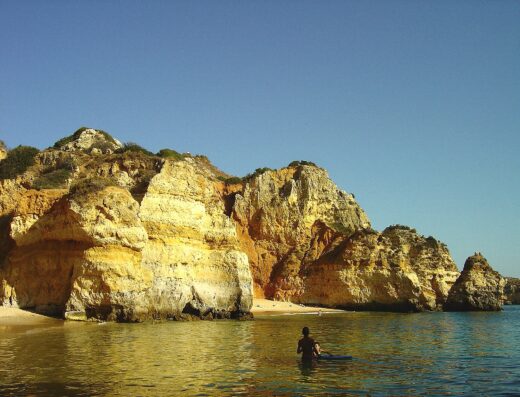
The defining feature of Praia do Poente is the height and closeness of the surrounding cliffs relative to the narrowness of the beach itself. The red-rock walls are stratified with visible bands of sediment — layers that tell the story of an ancient seabed. In the late-afternoon sun the cliffs glow a deep amber, which is partly why the beach rewards visitors who arrive later in the day rather than first thing in the morning when the light is flatter.
This is not a wide, open Atlantic beach. It is a cove — sheltered, warm, and compact. The contrast with nearby Luz (long, open, backed by a village) or Camilo (tiny, dramatically vertical, reached by a wooden staircase) is real but subtle. Poente feels less discovered. There are no sun-loungers, no hire kiosks, no boat trips launching from the shore. It is simply a beach.
The rock arch at the western end is the quiet signature detail. It is not large enough to walk through at high tide, but at low tide you can squeeze around it and find a small shelf of sand on the far side that most visitors never reach. That small discovery — earned with a wet scramble around wet rocks — is the kind of thing that makes people remember Poente after they have forgotten the more famous names.
The water at Poente is generally calm for much of the year. The cove faces south-southwest and is sheltered from the prevailing northwesterly Atlantic swells by the geometry of the surrounding cliffs. It is one of the more reliable swimming beaches in the Lagos area when other north-coast stretches are choppy or unsafe. Water temperature follows the standard Algarve seasonal pattern: cold in March and April (15–16°C), improving through May (17–19°C), and genuinely comfortable from June onward (20–22°C).
A practical local safety tip: the stone access stairs are slippery when wet — take care coming up after a swim, especially in winter and early spring when seaweed can coat the steps and make them treacherous. There are no lifeguards at Poente. The nearest lifeguarded beach is Praia da Luz, roughly 3 km east along the coast road. If you are visiting outside the summer months and planning to swim, note this and time your entry accordingly.
Poente works well as part of a coastal circuit from Lagos. The signed cliff path heading west from the beach connects with the Rota Vicentina network and runs above the coast toward Cabo de São Vicente — 30 to 60 minutes of easy walking with open Atlantic views. The path is well-maintained and waymarked.
For a half-day coastal itinerary: arrive at Poente early to have the beach nearly to yourself, walk west along the cliff path, then return east to Luz or Camilo for a late-morning swim in supervised shallows. Camilo is the closest dramatic cove — small, vertical, reached by a wooden staircase — with a very different, more turquoise character to its water. Poente’s amber warmth and rock arch feel like a different beach entirely, even though the drive between them is less than 10 minutes.
If you are based in Luz and want a quieter morning, Poente is close enough to combine with the coastal path east toward Ponta da Piedade (reachable by a separate path that branches from the main cliff-top route). The full Ponta da Piedade loop from Luz and back is a full morning or afternoon, but adding Poente to a Camilo visit makes for a natural two-beach morning.
Poente has no permanent facilities — no cafe, no showers, no sun-lounger rental. Bring water, sunscreen, and everything you need for the visit. It is a free-access public beach. The stone staircase means the beach is not wheelchair or pushchair accessible, and the narrowness of the sand at high tide means it is not well suited to large groups or anyone who needs space for beach sports.
The beach is best visited in May and June, when the road is quiet, the sand is at its widest (post-winter swell), and the afternoon light on the red cliffs is at its most striking. Autumn (September and October) also offers good conditions with fewer visitors than August.
About This Spot
-
General AreaNear Luz, Lagos
-
Coverage BadgeArchive
-
Best SeasonSpring
-
Difficulty1 Easy
Getting There & Access
-
Getting ThereAccessed from the EN120 coast road that runs west from Lagos toward Cabo de São Vicente. About 2 km past the Luz junction, a small signed pull-off appears on the inland side of the road. A short stone staircase descends through the cliff face directly to the sand — about two minutes once you have found the turn-off; the path is straightforward and requires no special fitness. Cycling is a genuine option: the EN120 is quiet outside peak season and the signed Ecovia do Litoral cycling route passes within a kilometre of the beach. By public transport, Lagos town centre is about 7 km east, reachable by bus or taxi.
-
Access TermsFree Public
-
ParkingInformal roadside parking at the pull-off. Fills quickly in July and August and can be very difficult on summer weekends — arrive before 10:00 or after 16:00 for the best chance of a space.
-
Best TimeAfternoon
-
Crowd LevelQuiet
Photography Notes
-
Shooting NotesSmall natural rock arch at the western end — easy to overlook; at low tide you can squeeze around it to a hidden shelf of sand most visitors never reach. Low tide also reveals tidal pools among the lower rocks on the eastern flank. Stratified red sandstone cliff bands make the backdrop.
-
Light & Sun NotesIn late-afternoon sun the cliffs glow a deep amber — the beach rewards late-day visits; morning light is flatter. The cove faces south-southwest.
-
ConditionsSheltered from prevailing northwesterly swells — generally calm water for much of the year, one of the more reliable swimming coves near Lagos. Sand narrows to 15–20 m at high tide and roughly doubles at low tide. Stone access stairs slippery when wet; no lifeguards (nearest at Praia da Luz, ~3 km east).
Visitor photos


Location
Log in free to see the exact pin and directions.




Leave a Reply
Been here? Add your shots.
Photos you add appear on this page with your name on them, next to the community gallery. Tell the next photographer what you found — the light, the crowds, whether it was worth the trip.
A free account also unlocks the exact pin, how to get there and the best time of day — on every spot.