Equinox Tide Walks: The Best Low-Tide Window of the Year on the Algarve Coast
Why the Equinox Tides Are Different
The Algarve’s tides are semidiurnal, meaning we get two highs and two lows per day. But the range varies dramatically through the year. Around the spring equinox, the sun sits directly over the equator, aligning its gravitational pull with the moon’s to produce perigean spring tides — the highest highs and lowest lows of the year.
At Lagos and Carvoeiro, this means the tidal range can exceed 3.5 metres. That doesn’t sound like much until you apply it to a coastline full of sea arches, offshore stacks, and rock platforms that are normally lapped by waves. At the lowest equinox lows, formations that are normally partially submerged become walkable. Caves that require a boat in summer become accessible on foot.
The window of maximum exposure typically falls on the morning of March 20th and the afternoon of March 21st — the two days of most extreme tidal pull.
Where to Walk: Four Locations at Maximum Low Tide
Benagil Sea Cave (Lagoa)
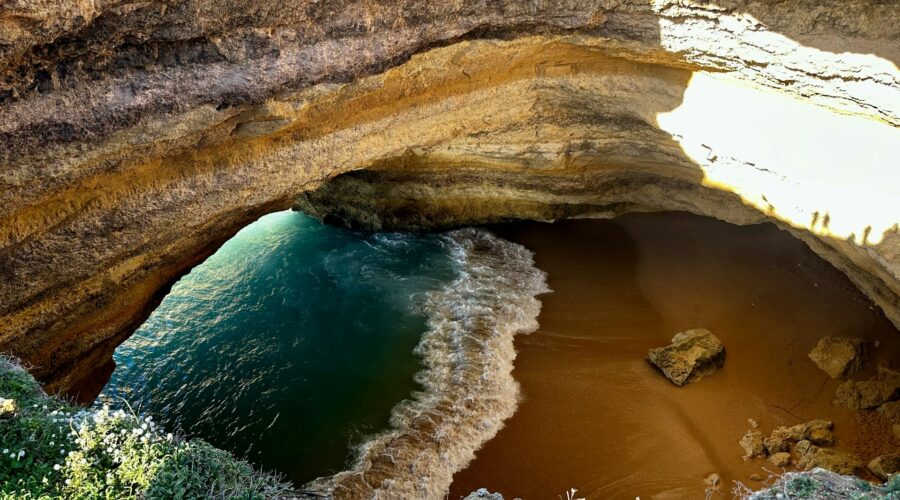
The famous cave with the sunlit ceiling hole is normally reached by kayak or boat tour. At equinox low tide, a sandbar forms at the cave’s mouth and you can walk in on foot. The approach along the cliff-top path from Benagil beach gives you the overhead view first — then descend the unmarked path on the east side of the beach when the tide permits. Check the tide table before you go; you typically need a negative coefficient tide (below 50 on the Portuguese scale) and you’ll have roughly 90 minutes of access once conditions allow entry.
Ponta da Piedade (Lagos)
The spectacular rock stacks and grottoes here are dramatic even at high water. At extreme low tide, the platform at the base of the lighthouse extends another 30 metres seaward, revealing a maze of tide pools between the rock formations. Look particularly in the northern coves — the shallow pools trap small crabs, sea urchins, and anemones in water warmed by the sun-heated rock.
Algar Seco (Carvoeiro)
The famous blowhole and cave system at Algar Seco sits on a wide rock platform. At equinox low tide, the platform extends to its maximum and the channels cut through the limestone become walkable channels rather than surging tidal cuts. The resident stingrays that normally hide in the deeper channels here move into the sunlit shallows — visible from the boardwalk without getting your feet wet, or accessible for a closer look if you scramble down to the platform with care.
Praia da Marinha (Lagoa)
The iconic arch and stack at the southern end of this beach are partially submerged even at moderate low tide. At equinox extremes, the rock bridge that connects the offshore stack to the cliff becomes a proper walkway rather than a scramble. The tide pools along the eastern side of the bay fill with colourful sea life and the clear water makes even small organisms visible from above.
Timing: How to Read the Tidal Coefficient
Portuguese tidal data uses a coefficient system (0–120). For equinox low-tide walks, you want a coefficient below 50 — these are the “mortes” (dead tides), the lowest of the year. The IPMA (Instituto Português do Mar e da Atmosfera) publishes daily tidal tables, as do several apps including “Tide Tables Portugal.”
The optimal window is the two hours around the actual low tide. Because the Algarve coast curves from east-facing (Ria Formosa) to west-facing (Sagres), the timing of the absolute low varies by 30–90 minutes between locations. At Lagos, the morning low falls around 7:00–9:00 AM in late March; at Faro, roughly an hour later.
Plan to arrive 30 minutes before the predicted low. This gives you time to assess conditions and walk out as the tide bottoms out, then back as water starts returning.
What You’ll Find in the Exposed Intertidal Zone
The expanded shoreline at equinox reveals the full complexity of the Algarve’s rocky coast:
- Limpets and barnacles: Dense colonies on the upper rock surfaces, active in the film of water left by receding tides. Easy to observe without disturbing.
- Sea urchin pools: Small depressions in limestone hold clear, warm water where purple and black urchins cluster. Don’t reach in — their spines are sharp and break off easily in skin.
- Hermit crabs: Particularly visible in empty limpet shells on the lower rocks. They’ll retract when you approach but make for easy observation from above.
- Anemones: Actinia species visible even at a distance as orange and purple dots in shallow pools. Like all intertidal animals, observe and leave them in place.
- Cormorants and shags: The diving birds work the exposed rocks at low tide, diving for fish in the deeper channels. Good from a distance; avoid any colony areas where birds are nesting (typically on sea stacks, March–July).
Local Safety Tip
The single biggest danger at extreme low tide isn’t the water — it’s getting caught by its return. The incoming tide comes in faster than most people expect on a shelving rocky coast. A 90-minute window can compress to 30 minutes of genuinely dangerous flooding as the Atlantic pushes back into the cave systems and coves.
Tell someone your planned location and return time. Don’t walk into sea caves or underarches without a visible exit route that isn’t submerged. If the water is already filling the channels you walked through to get somewhere, don’t try to cross — wait it out from a high rock or return the way you came the long way around.
The west-coast beaches (Praia do Amado, Carrapateira) have stronger surge than the east-facing Ria Formosa side. If you’re combining a low-tide walk with swimming, the Ria Formosa tide pools near Tavira and Culatra are gentler and warmer.
The Broader Window: Beyond March 20
The equinox is the peak, but the enhanced tidal range lasts from roughly March 15–25. If you’re in the Algarve during this window, even a moderate low tide on a non-equinox day will be more dramatic than the same tide in July. Watch the tidal coefficients — anything below 70 will give you meaningfully more beach and exposed rock than you’d see in summer.
For those who time it right, walking into Benagil cave on foot rather than by kayak, or watching cormorants diving in an expanded tidal pool at Ponta da Piedade, is one of those small rewards the Algarve occasionally offers for paying attention to what the coast is doing.
This piece was written for algarve.org and is free from commercial intent. Always check live tide conditions before planning a low-tide walk.