
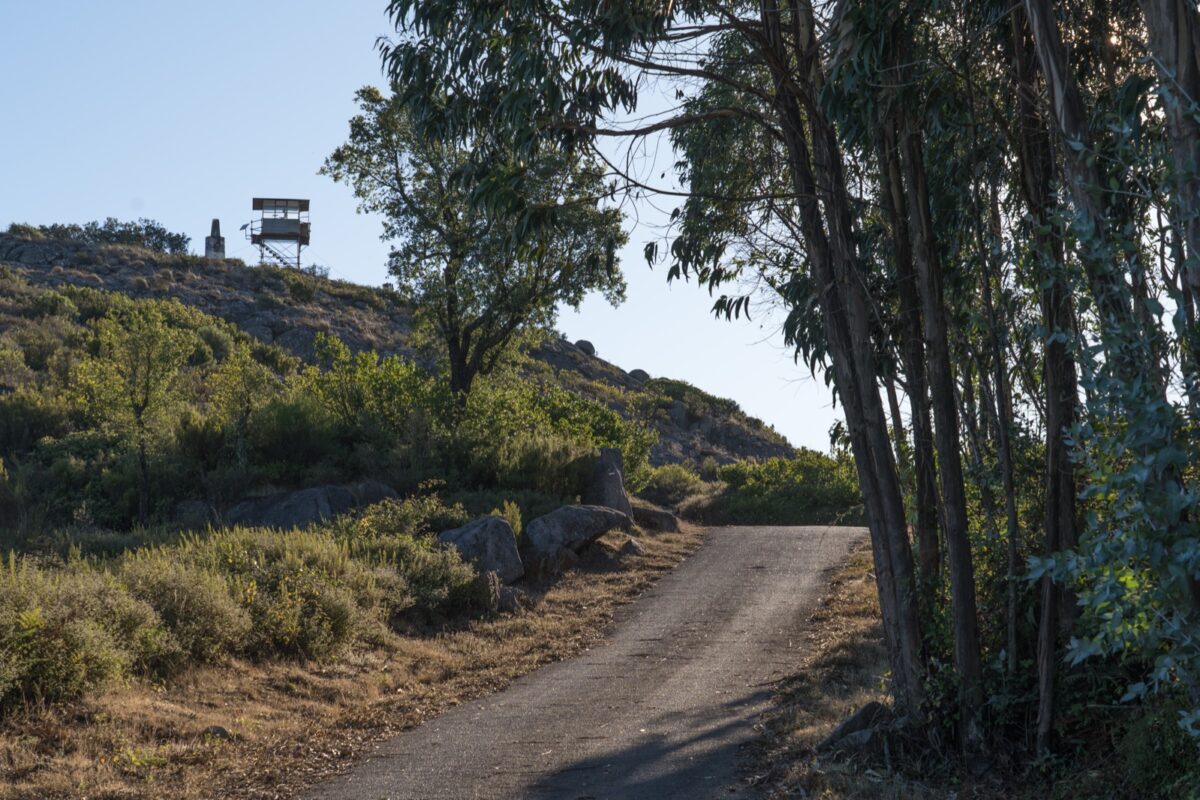
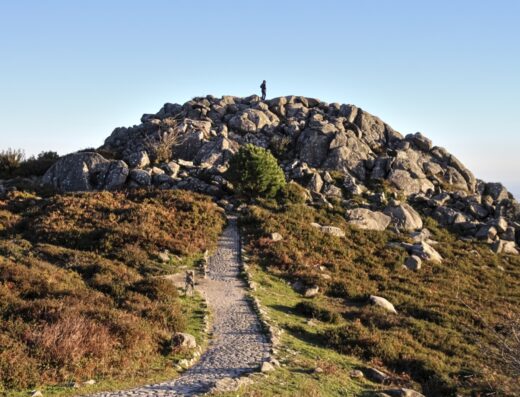
Picota is the Monchique summit for people who think Fóia gave itself away too cheaply. It’s the range’s second peak: lower than its famous neighbour, greener and rougher, and far more satisfying to stand on, because you arrive on foot instead of in a parking lot. The upper slopes are proper serra: cork oaks with stripped rust-red trunks, chestnut and arbutus, huge weathered boulders, terraced valleys falling away below.
The reward at the top is a view that argues with Fóia’s: the coastline from the Arade estuary across toward Lagos, the folds of the serra behind, and Fóia itself with its antennas across the valley, proof you picked the wilder hill. The summit boulders make natural foregrounds and perches.
When to go: spring is the peak of it: the serra turns green, wildflowers come through, and the air usually runs clearer than in summer haze. Autumn brings arbutus fruit and softer light. Summer is a hot, exposed climb; start early.
This is a real walk, not a stroll: steady climbing on tracks and paths, steep and stony in stretches, with little shade high up. Carry water and expect the summit to be cooler and windier than the valley floor. Waymarked routes cross these slopes, the Via Algarviana among them.
Who it’s for: hikers and landscape photographers who want the Monchique high country without a tour bus in sight. If you’d rather drive to your viewpoint, Fóia exists for that. Picota is for earning it.
About This Spot
-
General AreaNear Monchique, Monchique
-
Coverage BadgeArchive
-
Best SeasonSpring
-
Difficulty3 Advanced
Getting There & Access
-
Getting ThereThere's no summit road. Picota is reached on foot, on waymarked trails climbing from the Monchique side through cork oak country; the Via Algarviana crosses these slopes.
-
Access TermsFree Public
-
Crowd LevelQuiet
Photography Notes
-
Shooting NotesSummit boulders make natural foregrounds and perches; stripped rust-red cork trunks give the climb its colour. Fóia sits across the valley for context shots.
-
Light & Sun NotesSpring air usually runs clearer than summer haze; autumn brings soft light and arbutus fruit on the slopes.
-
ConditionsA real climb: steep, stony in stretches, with little shade high up. Carry water; the summit runs cooler and windier than the valley.
Visitor photos


Location
Log in free to see the exact pin and directions.

Leave a Reply
Been here? Add your shots.
Photos you add appear on this page with your name on them, next to the community gallery. Tell the next photographer what you found: the light, the crowds, whether it was worth the trip.
A free account also unlocks the exact pin, how to get there and the best time of day, on every spot.