Coastal Foraging: Wild Herbs and Edible Plants From the Algarve Shore
The Algarve shore in April and May is one of the Iberian Peninsula’s most generous foraging grounds, a season when the coast explodes with edible plants that most walkers pass without a second glance. If you know where to look and — crucially — what to leave alone, the cliffs, salt marshes, and Barrocal fringe offer a free, fascinating addition to any coastal outing.
Sea Fennel: The Signature Coastal Find
Sea fennel (Crithmum maritimum), known locally as funcho marinho, is the Algarve’s most celebrated wild edible plant and the one you are most likely to encounter. Look for it growing in rocky crevices and cliff-edge pockets along the entire southern and southwestern coast, particularly where sea spray keeps the rocks damp. The Cabo de São Vicente cliffs are one of the most reliable locations — the plants hug the rock faces just above the tide line, producing feathery, divided leaves with a thick, fleshy texture and a sharp, saline flavour that tastes like the sea itself.
Harvest the young spring shoots in April and May before the plant flowers. A brief blanch in olive oil with a little garlic transforms sea fennel into something extraordinary. The stems can be pickled, and the seeds, once dried, work as a seasoning. The flavour is entirely distinct from common fennel — more mineral, more direct, unmistakably Atlantic.
Rock Samphire: Handle With Care
Rock samphire (Crithmum maritimum — note the same species as sea fennel, though colloquially the name often refers to growth higher on the cliffs) grows in dense clumps on cliff-top rocks and in mortar lines of old dry-stone walls throughout the Barrocal zone. The common name sometimes overlaps with Artemisia crithmifolia, a different plant also found on Algarve cliffs. The confusion matters: rock samphire in the true sense is safe to eat in moderation. Its leaves are thick, waxy, and aromatic, with a salty bitterness that mellows significantly when cooked briefly in butter or blanched and dressed with lemon.
If you are on the cliffs near Sagres or along the southwestern headlands, look for low-growing clumps with fleshy, grey-green leaves. Avoid harvesting more than a third of any single plant — it regenerates slowly, and popular spots are already under pressure.
Wild Thyme and Oregano
The Barrocal zone — that transitional band between the coastal lowlands and the limestone uplands — is where the dry-stone walls and rocky substrate create perfect conditions for wild thyme (Thymus zygis and Thymus capitatus) and Origanum virens. April and May represent the peak window: the plants are in active growth, the leaves are fully flavoured, and the small purple and pink flowers have not yet opened, which means the essential oils are concentrated in the foliage rather than the blooms.
The best access is along the walking paths between Barrocal villages — particularly near the walls and terrace edges that characterise the agricultural landscape around São Brás de Alportel and the inland approaches to the coastal cliffs. Bring scissors, not a bag, and take only what you can comfortably fit in your palm. Wild thyme dries beautifully and holds its flavour for months.
Edible Succulents: Ice Plant and Sea Beet
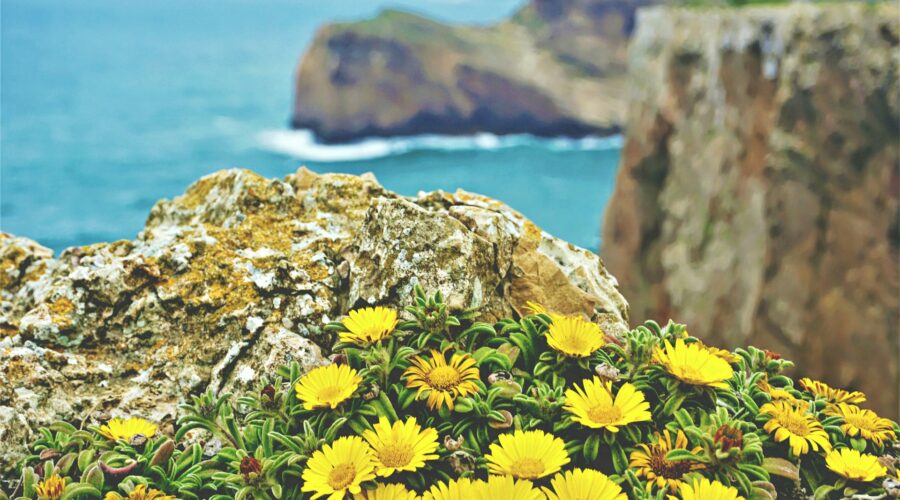
Two edible succulents deserve attention. The ice plant (Carpobrotus edulis), an invasive species originally from South Africa now widespread along sandy Algarve shores and cliff-base flats, has fleshy, jade-green leaves and a mucilaginous texture when raw. The leaves are technically edible — they can be sliced and added to salads for a slight crunch — but this plant is best admired rather than harvested, given its impact on native dune vegetation.
More interesting for the forager is sea beet (Beta vulgaris subsp. maritima), the wild ancestor of chard and beetroot. It grows in the salt marsh margins of Ria Formosa, particularly along the tidal creeks and muddy channels that cut through the reed beds. The young leaves are excellent raw in salads; older leaves need wilting and cooking like spinach. The plant has a sturdy, ribbed leaf with a waxy sheen and a taste that is earthy, slightly salty, and much more complex than anything you will find in a supermarket.
The Barrocal Dry-Stone Walls: A Vertical Garden
The traditional dry-stone walls of the Barrocal zone are one of the Algarve’s most overlooked ecological features — and for the forager, they function as a vertical garden. The crevices and moss lines trap moisture and organic matter, creating microhabitats where wild herbs concentrate. Wild rosemary (Rosmarinus officinalis), carob tree seedlings, and various wild mint species all appear in wall-top vegetation, particularly along lanes between Estói and the coastal fringe.
Walking a Barrocal lane in late April, you are effectively moving through a medieval herb garden that nobody planted and nobody tends. Take a moment to crouch at the base of a wall and look up: the diversity is remarkable.
Safety Disclaimer
Know before you eat. This guide covers commonly recognised edible plants in the Algarve. Many coastal plants have toxic look-alikes — wild parsley, hemlock, and various Euphorbia species can be fatal. If you cannot identify a plant with absolute certainty, leave it where it is. The rule is simple: if there is any doubt, there is no doubt. Carry a good regional field guide, forage with someone experienced for your first visits, and never eat anything raw for the first time without confirming identification with a second source. The coast will still be there tomorrow. The same cannot be said for a hospital visit.