Spring Reptile and Amphibian Watching in the Algarve
The Algarve’s reptile and amphibian populations remain among Europe’s most overlooked wildlife treasures. While birdwatchers flock to the Ria Formosa and butterfly enthusiasts chase swallowtails across wildflower meadows, the region’s scaly and slippery residents go largely unnoticed — basking on stone walls, swimming in seasonal ponds, and hunting through cork oak forests.
April is prime time. Reptiles have emerged from winter dormancy and are actively thermoregulating (basking) to raise their body temperatures. Amphibians are breeding in temporary pools before summer dries them out. This is your window.
Why April Is Prime Time
Spring in the Algarve creates perfect conditions for cold-blooded wildlife:
- Temperature — Daytime highs reach 18-22°C, warm enough for reptile activity but not too hot for comfortable observation
- Basking conditions — Morning sun warms rocks and walls, attracting thermoregulating reptiles
- Breeding activity — Amphibians congregate in ponds to breed, making them easier to locate
- Vegetation — Spring growth hasn’t yet become the dense summer scrub, improving visibility
- Low tourist pressure — Most wildlife hotspots remain quiet until May
Where to Look
Ancient Cork Oak Forests
The semi-natural cork oak woodlands of the Barrocal and Serra de Monchique provide prime habitat. The mosaic of oak, maquis shrubland, and open grassland creates hunting grounds for predators and basking sites for reptiles.
Best spots: Around Monchique (south-facing slopes), between Silves and São Brás de Alportel, near Alcoutim
What to find: Ocellated lizards, ladder snakes, and fire salamanders
Stone Walls and Rural Tracks
The Algarve’s agricultural landscape is dotted with ancient stone walls — perfect basking sites for wall lizards and geckos. Rural dirt tracks, particularly those with sun-exposed margins, attract snakes and lizards crossing between habitats.
Best spots: Roads between Loule and Salir, tracks near Odiaxere, rural lanes in the Tavira area
What to find: Portuguese wall lizard, psammodromus, and Montpellier snake
Seasonal Ponds and Wetlands
Spring rains fill temporary ponds — locally called “charcos” or “lameiros” — that host breeding amphibians. These seasonal wetlands are critical habitat and often dry completely by June.
Best spots: Near Monchique (Ribeira de Monchique valley), the upper Rio Arade catchment, low-lying areas near Ria Formosa
What to find: Iberian spadefoot toads, fire salamanders, and natterjack toads
Coastal Dune Systems
The stabilized dunes between Faro and Tavira, and the wilder dunes of the western coast, host specialized reptile species adapted to sandy conditions.
Best spots: Dune system between Faro and Olhão, Praia do Barril area, dunes near Odeceixe
What to find: Moroccan wall gecko, ocellated lizard, and sand lizards
Species You Might Encounter
Reptiles
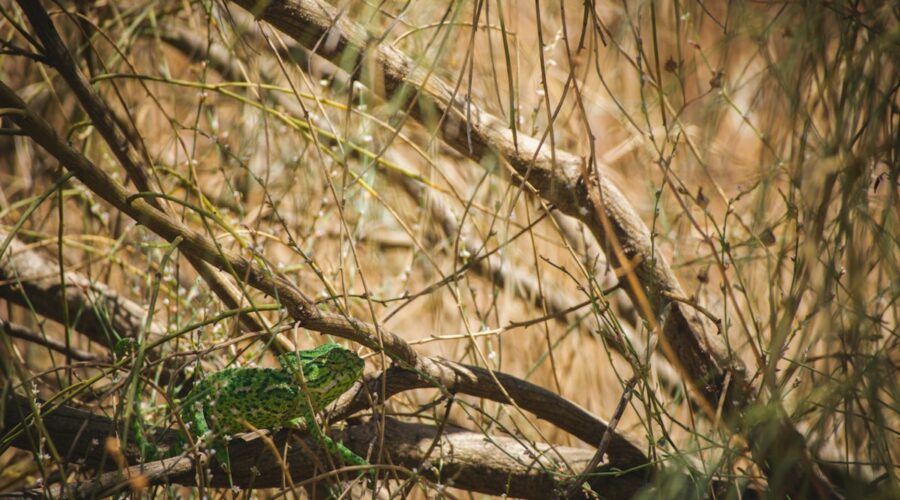
OCELLATED LIZARD (Timon lepidus) — The Algarve’s largest lizard, reaching 60cm or more. Adults are spectacularly patterned with green, blue, and black. Found in cork oak forest edges and stone walls. Harmless but can bite if handled.
PORTUGUESE WALL LIZARD (Podarcis lusitanicus) — Small, agile, and common. Males display green coloration during breeding season. Found on walls, rocks, and sunny paths throughout the region.
PSAMMODROMUS (Psammodromus algirus) — The “large Psammodromus” is a swift, ground-dwelling lizard of heathland and maquis. Brown/grey with pale stripes. Runs for cover at the slightest disturbance.
MOROCCAN WALL GECKO (Tarentola mauritanica) — Nocturnal but often visible during day on sunny walls. Distinctive “tomato” shape. Found on village walls and rural buildings throughout the Algarve.
LADDER SNAKE (Rhinechis scalaris) — Non-venomous, reaching 150cm. Named for ladder-like patterns on juveniles. Found in cork oak areas, hunting rodents and lizards. Completely harmless to humans.
MONTPELLIER SNAKE (Malpolon monspessulanus) — Portugal’s largest snake, reaching 200cm+ rear-fanged and mildly venomous (harmless to humans with normal skin). Found in rocky areas and maquis. Often seen crossing roads in evening.
Amphibians
IBERIAN SPADEFOOT TOAD (Pelobates cultripes) — Burrowing toad with distinctive vertical pupils. Found in temporary ponds in spring. Emits a low, duck-like croak.
NATTERJACK TOAD (Epidalea calamita) — Small, warty toad with distinctive yellow stripe down the back. Found in sandy coastal areas and inland heaths. Males call from breeding ponds with a loud “kek-kek-kek.”
IBERIAN GREEN TOAD (Bufotes sp.) — Variable in coloration, often green with dark spots. Found in a range of wetland habitats. Less common in the Algarve than elsewhere in Portugal.
FIRE SALAMANDER (Salamandra salamandra) — Striking black and yellow. Found in damp areas near streams in the Monchique hills. Strictly nocturnal, often crossing wet roads at night.
STRIPED ALMOND TREE FROG (Hyla meridionalis) — Tree frog with distinct lateral stripes. Calls loudly from reed beds and water margins. Often found in garden ponds near rural properties.
Equipment and Techniques
- Binoculars — Essential for observing reptiles from distance without disturbing them
- Camera with telephoto — Many species are small and wary; a 200mm+ lens helps
- Headlamp — Essential for night searches (fire salamanders, amphibians)
- Field guide — “Amphibians and Reptiles of the Iberian Peninsula” or similar
- Rubber boots — For wetland exploration
Observation Tips
- Early morning — Reptiles are most active basking between 8-11 AM
- Evening — Amphibians become active as temperatures drop, especially after rain
- After rain — Both reptiles and amphibians become more active
- Move slowly — Quick movements flush animals before you see them
- Check walls — Stone walls retain heat and attract basking reptiles
- Listen — Amphibian calls carry across wetlands; use them to locate breeding sites
Ethical Guidelines
- Observe from distance — Never touch, chase, or capture wild reptiles or amphibians
- Don’t turn rocks — This destroys microhabitats and exposes animals to predators
- Stay on paths — Avoid trampling sensitive vegetation
- Don’t use flash — Flash photography stresses animals
- Report sightings — Citizen science databases help conservation efforts
The Hidden World
The Algarve’s reptiles and amphibians occupy a hidden world beneath the notice of most visitors. They’re there — in the wall beside your restaurant lunch, in the pond beside your hiking trail, in the garden of your accommodation. You simply have to look.
April brings them out in force. The thermoregulation imperative drives them to sun-exposed surfaces. The breeding imperative drives amphibians to water. This convergence creates more observable wildlife than at any other time of year.
All you need is patience, slow movement, and eyes tuned to the small movements that betray their presence. The reward is encounters with creatures that most humans share their environment with for years without ever seeing.