The Best Time to Visit Ponta da Piedade (Hint: It’s Not July)
There’s a Reason Every Algarve Photo Looks Like This
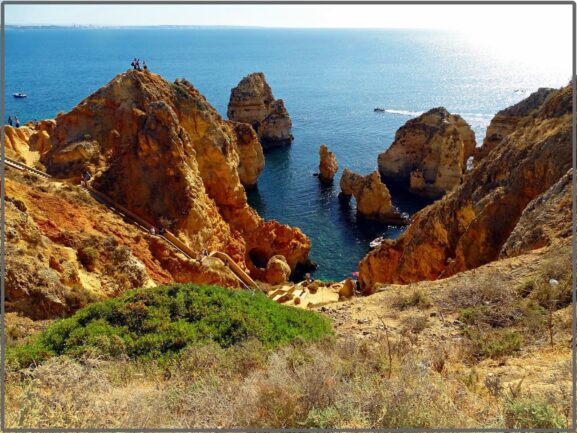
If you’ve seen an image of the Algarve and thought, “that can’t be real” — the orange-gold sea stacks rising out of turquoise water, the arched rock formations and deep carved grottos, the cliffs stacked up in impossible formations — there’s a good chance you were looking at Ponta da Piedade.
It’s the coastline that shaped the Algarve’s identity as a travel destination: the cliffs that appear on posters, the formations that show up in every “top 10 Portugal” feature, the viewpoint that confirms, the moment you step out of the car, that yes, this is actually what it looks like.
It also happens to be completely free to visit. The viewpoint, the clifftop trail, and the staircase down to the water are all public access, no entry fee, no booking required. And in spring — before the summer numbers arrive — it is, without exaggeration, extraordinary.
What Ponta da Piedade Actually Is
Ponta da Piedade is a headland just south of Lagos, at the western end of the town’s beach stretch. Over millions of years, the Atlantic has carved the soft golden limestone into arches, sea stacks, caves, and grottoes — a sculptural landscape of golden stone and turquoise water that looks, depending on the light, somewhere between a dream and a geology textbook.
The cliffs here reach about 20 metres above sea level. At the viewpoint you look directly down into channels of clear water threaded between rock pillars, with the open sea visible beyond. In the right conditions — morning light, late afternoon sun, or the few minutes around golden hour — the colour of the stone and the colour of the water do something so photogenic it feels almost deliberately theatrical.
It isn’t theatrical. It’s just limestone, time, and the sea. Which somehow makes it better.
Why Spring Is the Right Time
Ponta da Piedade in July is still beautiful — it’s impossible for it not to be — but it’s also busy in the way that the most famous viewpoints in southern Europe tend to get busy. The car park fills up. The clifftop path has queues at the best angles. The experience, while still good, becomes a slightly crowded version of the photos you’ve already seen.
In spring, especially March and April, it’s a different proposition entirely.
The cliffs are yours — or nearly. You can take your time at each viewpoint, step back and forward, let the light change without someone asking if you’re done. The sea in spring is extraordinary: clear and alive, with no summer haze, the blues and greens fully saturated. The wildflowers that line the clifftop path are in bloom — yellow and white and pale purple against the orange rock, another visual layer that summer crowds won’t find.
And the light. The spring sun sits lower than in summer, hitting the cliffs from a more oblique angle and bringing out the gold in the stone in a way that afternoon photography in July rarely matches.
How to Explore It (For Free)
The main viewpoint at Ponta da Piedade is signposted from Lagos and accessible via a free public car park. From the parking area it’s a short walk to the lighthouse — a small working lighthouse that adds a navigational frame to the scenery — and then along the clifftop path to the first set of viewpoints and stairs.
The stone staircase down to the water level is public and free. It descends in several flights to a small platform right at the waterline, where the rock formations surround you on three sides and the sea pushes gently in and out of the grottos. Standing there at low tide with the rock walls overhead and the water perfectly clear below is one of those travel moments that doesn’t require any words.
The full clifftop trail connects Ponta da Piedade northward to the beaches closer to Lagos town (Meia Praia direction is east; the beaches of Praia de Dona Ana and Praia do Camilo are just to the north). This means you can walk the whole stretch — viewpoints, cliff edge, staircase, beach — in a single linear route and arrive somewhere you can sit in the sand at the end of it.
Practical Details
- Getting there: From Lagos town centre, Ponta da Piedade is around 2km south. The road is signposted. You can drive (free parking at the headland), cycle (the road is quiet and pleasant), or walk the cliff path from Lagos in about 25–30 minutes.
- Entry cost: Nothing. Free viewpoint, free stairs, free clifftop path.
- Best time of day: Late afternoon in spring for golden light on the cliffs. Morning works well for photography into the grottos when the sun is lower. Avoid midday when the light is harsh and flat.
- The stairs: Around 180 steps down to sea level. Manageable at a steady pace, but not suitable for those with significant mobility difficulties. The clifftop viewpoints are accessible without the descent.
- Tides: Low tide opens up more of the rock platform at the bottom and makes the grottos more accessible. High tide is still dramatic — the water comes closer to the cliff walls and the surge into the caves is audible. Check tide times for your visit date.
- Footwear: The stone stairs can be slippery if wet. Closed-toe shoes or trainers are much safer than sandals on the descent.
- Crowds: In spring you’re generally fine at any time. By late June, late afternoon becomes the busiest window — arrive around 5pm and you’ll share it; arrive at 9am and you may well have it to yourself.
What to Do After
Praia do Camilo is a ten-minute walk north along the cliff path — a small, sheltered cove reachable via a long wooden staircase and one of the prettiest pocket beaches near Lagos. It’s swimmable from spring onwards on calm days and, like Ponta da Piedade itself, free to access.
Praia de Dona Ana is slightly larger and has facilities in season (sunbed rental if you want it, a beach bar nearby), but the beach itself is always free. In spring neither beach has the density of people that makes July swimming feel like a negotiation.
Lagos old town is 2km back along the road — the historic centre has a free-to-wander Moorish wall section, the town market (Mercado Municipal), and a network of cobbled streets worth an evening stroll. It pairs naturally with a Ponta da Piedade afternoon.
A Note on the Boat Tours
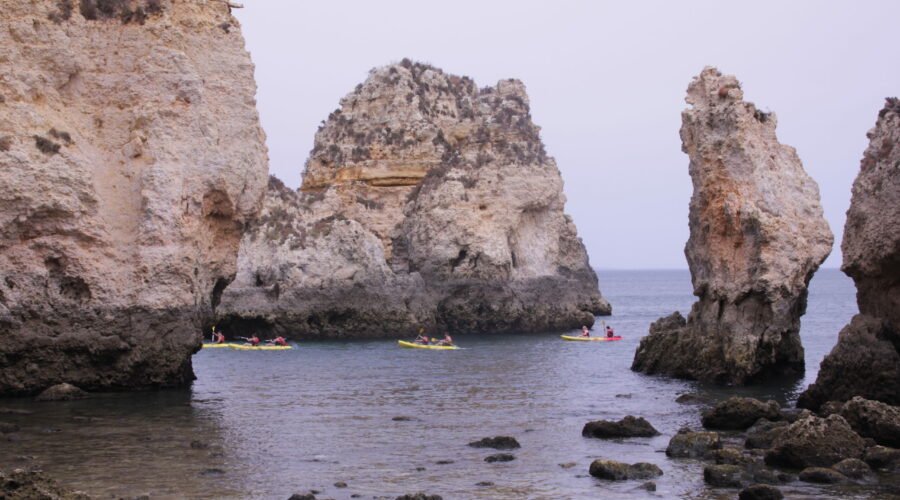
You’ll see boat tours advertised for Ponta da Piedade — they paddle you through the grottos from the sea and the perspective is undeniably different. Those are commercial operations and outside the scope of this guide, but they do exist if you want them.
What’s worth knowing is that you don’t need them to experience the place properly. The staircase and the clifftop trail give you everything — the views from above, the water-level perspective from the platform at the bottom, and the grottos visible from land. It’s a complete experience on its own terms, and it costs nothing.
Why This Is Worth Planning Around
Ponta da Piedade is one of those rare places where the photographs, however good, fall slightly short of the real thing. The scale, the colour, the sound of the sea in the grottos — these don’t compress into a screen very well. You need to stand there.
Spring gives you the best version of that moment: uncrowded, perfectly lit, with wildflowers on the path and the whole Algarve coast stretching away in both directions. It’s free to access, 25 minutes walk from Lagos, and one of the most beautiful coastal viewpoints in Europe.
Go in the afternoon. Take the stairs. Stand at the bottom and look up at the rock walls. And give yourself longer than you think you need — because you’ll want to stay.